
By Elton Bondi
It could be correctly argued that for the size of our economy, and our population, South Africa had, and I think in many ways may still have, one of the most vibrant general aviation sectors in the world.
For example, there was a time that we had in South Africa, the longest standing and most successful Cessna and Piper dealerships outside of the USA. And we were once second only to America with regard to the ratio of aircraft owners to pilots. In other words, only in USA did a higher percent of pilots own their own aircraft, than in South Africa.
I have understood that there are several reasons why we “punched way above our weight class” in aviation. Some include – our great weather, our vast land that did not always have a comprehensive road and rail infrastructure increasing the need to fly to different villages, towns and cities. And importunately because of our massive contribution to the Allied effort during the Second World War.
From the early 1940s South Africa in a few short years, was able to train tens of thousands of pilots, observers, bombardiers, navigators, gunners and other aircrew.
This effort saw scores of training airfields spring up all over the country in a matter of months, turning small sleepy rural towns into busy aviation training hubs each training thousands of pilots annually. After the war South Africa was left with significant airfield infrastructure (runways, hangars, barracks, etc.), as well as abundance of skills (aircraft engineers and flying instructors). And importantly an abundance of military surplus aircraft like the venerable Tiger Moth. Which flying clubs, flight schools and individuals were able to purchase and operate at relatively low cost. All this enabled a solid aeronautical foundation from which sprouted generations of pilots, and which is still evident today.
Perhaps one of the greatest indicators of both the vibrancy of, and the appreciation for, aviation in any country are its airshows. How many are there in a year? How well attended are they? and what is the variety and caliber of the performers. And here too South Africa excelled beyond the size of our economy.
The glory days of South African general aviation and airshows do not necessarily hark back many decades to the immediate post war boom era of the 1950s and 60s. As recently as 2005 to 2010, could also be regarded as a golden era of South African airshows. And I think that all those that were a part of it knew and appreciated that it was a special time, we thought it would never end.
When I started flying in the late 1980’s, long before I flew aerobatics, the airshow world in South Africa was dominated by either current or past military pilots. And nearly all display pilots were professionals. Most formation displays were military with only two
highly professional display teams from the civilian sector. But all the pilots on these civilian teams anyway had successful military flying careers.
As the years rolled by, more and more civilian pilots slowly entered the airshow arena. I started flying at a few small airshows during that transition stage where airshows went from being mainly military dominated to having a greater civilian participation. And I readily admit that some of those pre-show briefings were for me quite intimidating. At times I had to wonder, were we going to be flying an airshow today, or going on a mission to bomb a heavily defended military installation? The culture and intensity was military all the way.
As military participation in airshows waned, the shortfall was more than made up by civilian performers, as more private pilots acquired an array of exotic aircraft in great demand at any airshow. As a result, our airshow sector blossomed.
The most tangible example of this was a period where at just one airport (Rand) I think there must have been the highest concentration of airshow teams based at one field anywhere in the world.
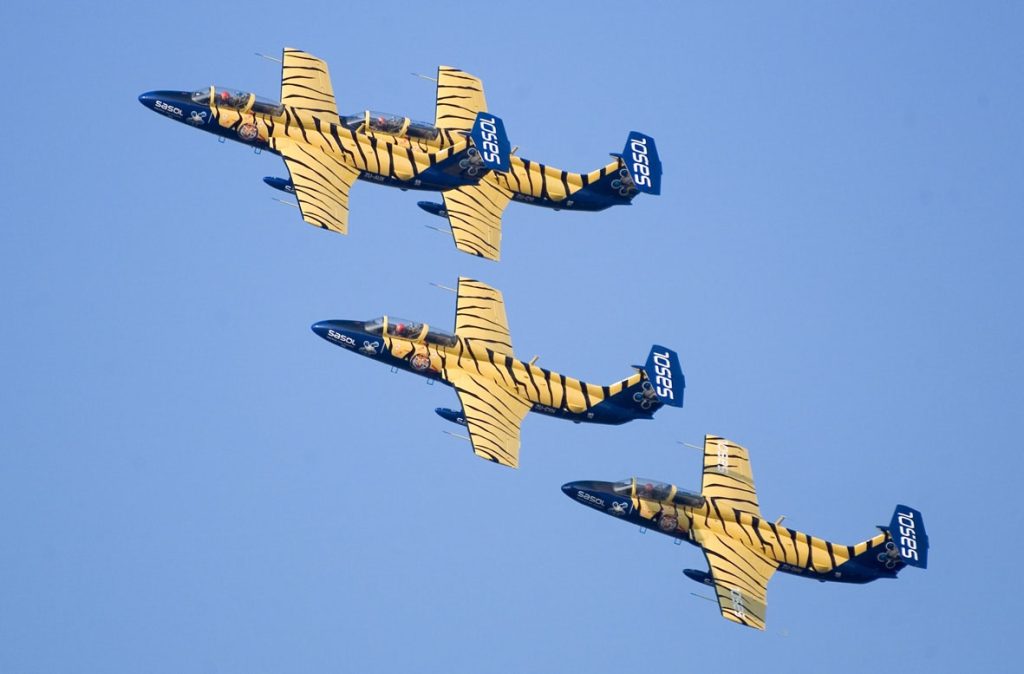
For a few glorious years we had – 2 four-ship Pitts Special teams (Chubb and Smirnoff), 1 four-ship Harvard team (The Flying Lions), 1 three-ship Zlin 50 team (Mazda), 1 four-ship L29 civilian formation jet team (SASOL Tigers), 1 two-ship L39 jet team (Hit & Run), A Yak 52 team, and even a couple of humble Vintage De Havilland Chipmunks. That makes it 8 formation teams all based at one airport! I do not think that any airfield anywhere has seen this?
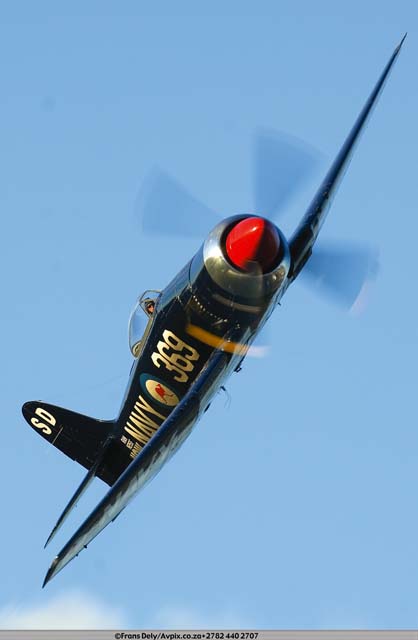
In addition to all these formation acts, there was also sprinkling of extremely talented pilots who flew exotic aircraft such as RVs, Sukhoi’s, Yaks and Extras including a South African World Champion (the great Glen Dell) as well as a very active Durban based Yak 52 formation team. And of course, we had a few war birds to add to the South African mix, including a Yak3, a Hawker Sea Fury, A Mustang and for a short time a MkIX Spitfire.
There were scores of airshows held annually all around the country and all were very well attended. Some were organized by local flying clubs, and some by local Government, for example the Kwa-Zulu Natal annual tour, aimed at promoting aviation in more rural areas. And some were sponsored by large corporations such as the great FNB Jozi show which combined the traditional Rand Airshow with an airshow near Soweto at the same time. Performers were cleverly scheduled to shuttle between the two display sites (a few flying minutes apart) in such a way that pilots were not under undue pressure and both venues always had an active display line.
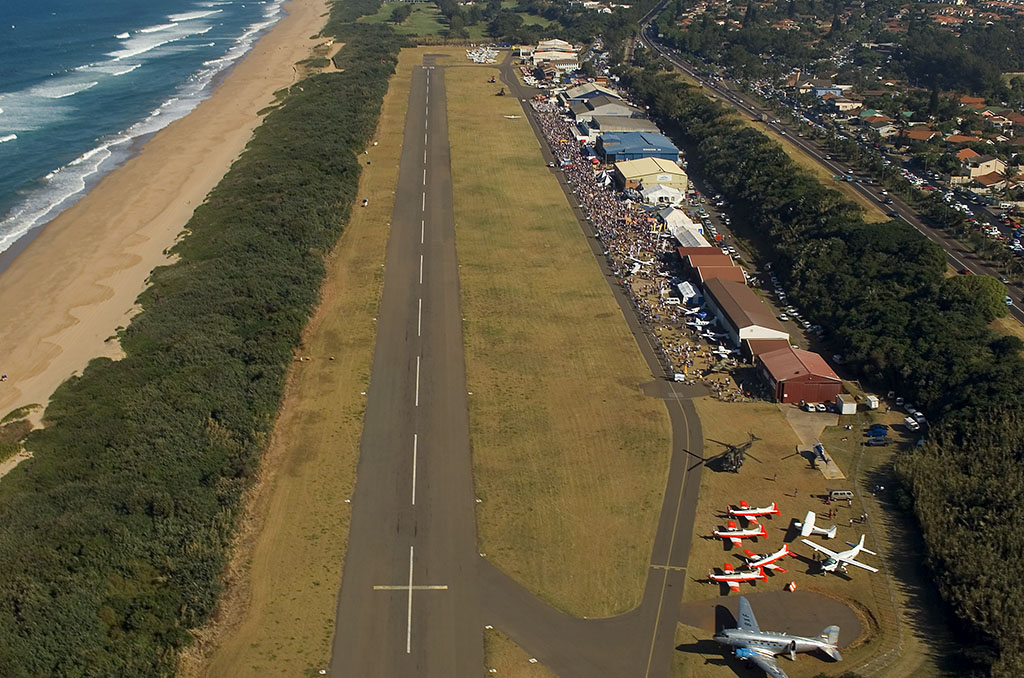
So what has happened, and why? Today there are only a handful of teams, and individual performers, and significantly less airshows are being scheduled each year, and many of these get cancelled as the due date comes closer.
There are several reasons –
A massive factor has been economics – in Rand terms operating airshow airplanes has been getting increasingly expensive, pricing them out of the range of many individual owners and even potential sponsors.
In addition, we have lost an alarmingly high number of pilots to accidents. It pains me to admit this as they were all close friends, but with an increase of civilian participation it is I think fair to say that a less disciplined and structured ethos entered the arena, and in this unforgiving world accidents become inevitable. I don’t mean to be disparaging, after all I am amongst the civilian quarter, but you cannot compare the discipline and safety protocols of a private individual to an airforce pilot who flys a government aircraft, and who reports to a squadron safety officer as well as a commanding officer.
Regulation is another factor. In response to a rising accident rate, local authorities and other relevant bodies, understandably increased the burden of adherence to more stringent regulations. The barriers to entry for new performers increased. Airshows were no longer a case of a local flying club putting up a few adverts, setting up a few food stands, inviting a few pilots and hosting a show. Permissions and other strict rules now applied. I emphasize that this was all very understandable and sensible given the context of the time.
But unintended consequences were that it became more difficult and onerous to become an airshow pilot, and it also became both administratively burdensome and expensive to host an airshow.
And so, a cycle commenced, less airshow pilots meant less variety, less variety meant less public attraction, increased operational costs meant higher gate fees, higher gate fees meant less crowds, less airshow crowds meant less airshows and less airshows meant less sponsorship. And so on.
But all is not lost and there are glimmers of light, with some highly innovative and entertaining new teams like the brilliant Navion formation. As well as new and improved incarnations of older teams, like the Master Power Extra duo and the Marksmen, both truly world class acts. And of course, there are the two foundation Pitts teams and our very popular Harvard team. And there are also a few new and highly talented individual acts in both rotorcraft and fixed wing aircraft.

The willingness and enthusiasm of airshows pilots remains strong, and I believe that the South African public still regard airshows as wholesome family entertainment.
We have the basic ingredients to work with, what is needed is a combined and concerted effort to revive airshows in South Africa. No single player can do it alone. The regulator, the pilots, the administrative bodies, corporate sponsors, insurers and other relevant players need to have a summit to plan the next golden era of South African airshows.