Beginners guide to Aerobatics
There is nothing more challenging or exhilarating in aviation than aerobatics, yet many pilots feel that this is beyond their capabilities, but it should not be so. Basic aerobatics can teach pilot skills that might one day be beneficial should they get into a bad situation during landing, slow flight, instrument/night flying, bad weather or when showing off. Yip, some of you needed that last one. Feeling the controls all the way against the stop while in an unusual attitude is, for the uninitiated very unsettling, but super addictive once you understand the how’s and whys of basic aerobatics. As you would already know,

Stalling, Autorotation and Spinning – Part 5
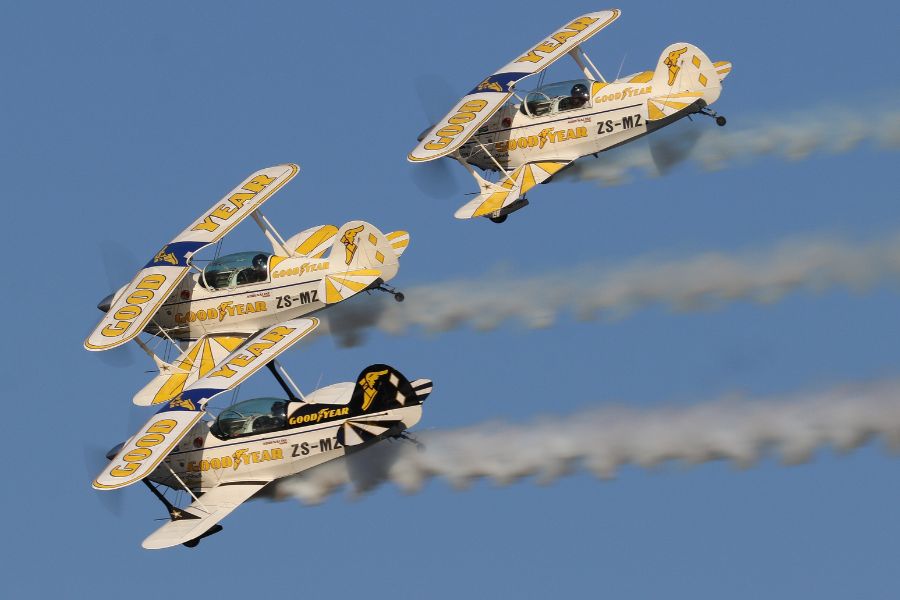
SNAP ROLLS Part 5 deals with what earlier generations of aviators called “flick rolls”, but what are now called “snap rolls”. These manoeuvres are directly linked to the concept of autorotation as described in Part 1 of the “Stalling, Autorotation and Spinning” series. Read part 1 here. So…Imagine that a Pitts Special S2 aerobatic biplane at its maximum aerobatic weight is flying straight and level in one “g” flight. If the engine is throttled back, the airspeed will start decaying and the angle of attack of the wings will need to be increased so as to provide sufficient lift to maintain the

RENO AIR RACES
Officially now known as the STIHL National Championship Air Races, this event is a multi-day affair that takes place each September at the Reno Stead Airport a few miles north of Reno, Nevada. Air racing at Reno is one of the few remaining venues still around, and the event features six racing classes. Additionally, Reno offers a large display of static civil and military aircraft, vendors and various flight demonstrations. HISTORY Begun in 1964, the Reno Air Races feature multi-lap, multi-aircraft races among extremely high performance aircraft on closed oval courses which range between from around 3 miles (4.8 km) for Biplanes and Formula One

Stalling, Autorotation and Spinning – Part 4 – The Recovery from a Spin
We now have a reasonable understanding as to how an aircraft might behave in a spin. We know that if we are to achieve and maintain a steady state in a spin that we have to “default” to a situation in which the stick is being held fully backwards, the ailerons are being kept neutral, the rudder is fully applied, and the throttle has been pulled back so that the engine is at idle power. It is vital to meet all of these conditions if a quick and uneventful recovery is going to be affected, this being, after all, exactly what we

For the love of inverted flight
We’ve done a lot of inverted flying in formation in the past. The goal is to explore different formations and manoeuvres with various aircraft to incorporate into our airshow routine. It was not love at first flight When I started flying aerobatics 30 years ago, I found inverted flight very uncomfortable. You hang in your straps, are pushed out of your seat, and blood rushes to your head. It feels as though your eyes are going to pop out, after which you’ll be ejected from the cockpit and fall to your death. Back then I quickly realised that flying inverted was going

Incipient spins, autorotation and spinning – part 3
Keeping it safe during a fully developed spin Part two dealt with how an aircraft transitions from the autorotation phase to the fully developed spin. If your memory is hazy as to how and why this happens, please read part two again here. An engine stoppage is always a possibility when doing a spin. In an American aircraft the propeller turns clockwise as viewed from the cockpit. Therefore, in a spin to the right, the aircraft will be moving in the same direction as the rotation of the propeller so that there is often a very noticeable “slowing down” of the r.p.m.

UNITED AIRLINES and OSHKOSH
Why did United Airlines take a brand new 737 MAX-8 to the Oshkosh AirVenture airshow? As many of us know, EAA AirVenture is the world’s biggest airshow in terms of aircraft numbers. ‘EAA’ stands for ‘Experimental Aircraft Association’, so there is a strong focus towards homebuilt aircraft. However EAA has always welcomed owners of all aircraft, whether general avaition, military, bizjet, helicopters or even airlines. In past years, bringing large aircraft to Oshkosh was not a big deal, but what makes this appearance by United Airlines unique, is that they were punting their ‘AVIATE’ training initiative on the search for new pilots. Before

Recreational flying – is it always worth it?
To be clear, this article does not refer to people who fly professionally, or for some utilitarian or practical purpose such as to regularly commute to faraway places for work or leisure. For these pilots, the ends justify the means. The focus here is on people who choose to purchase and / or fly aircraft purely for the fun of it, with no enduring practical objective. Pilots who buy and fly for example – cantankerous vintage aircraft, or impractical single mission aerobatic aircraft, or in fact any general aviation aircraft that they might use occasionally to travel to places, but most of

The incipient spin and auto-ration – part 2
From Auto-ration to the fully developed, steady state spin Part one dealt with how the phenomenon of autorotation provides the “motor” to drive a spin. If your memory is hazy as to how and why this happens, please read part one again. During the early stages of the autorotation, there are only four significant aerodynamic moments present, those being: The low lift and high drag of the down-going wing. The higher lift and less drag of the up-going wing. The effect of up-elevator input in keeping a high value of angle of attack. The rudder input that caused the yaw and induced
Tricky Maneuvers!
Have you ever wondered what maneuver Ron Wheeldon struggled with the most? He answers this- and shares a (very wobbly) experience!

A look back – Playing for Keeps
In the mid 80’s the late Peter Celliers organized a “World Masters Aerobatic Competition” that was hosted at the La Mercy Airfield on the Kwazulu Natal Coast of South Africa. He invited some of the best competition aerobatic pilots in the world to participate. There were a limited amount of aircraft and aircraft types. This would ensure that all the pilots would fly aircraft of similar performance. The thinking being that this would be somewhat of a handicapping system, allowing the skill level of the pilots to be the predominant decider of a winner, rather than the performance of an aircraft. My

The incipient spin, autorotation and fully developed spins
Part 1 – The incipient spin and autorotation The subject of aircraft spins is vast, almost limitless, in fact. This is the first of a four-part series focused on the phenomenon In later articles, I’ll cover the fully developed spin and recovery, as well as flat, inverted and accelerated spins. Since many of the principles of autorotation are contained in the execution of “flick” or “snap” rolls, these will also be explained. There are three phases associated with the build-up to a spin. The first is the incipient spin and the second is autorotation, when newly created aerodynamic factors begin to drive