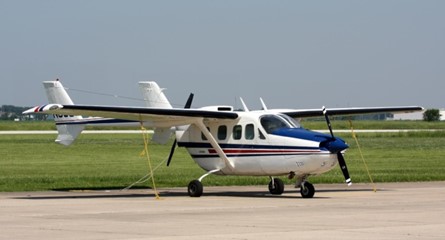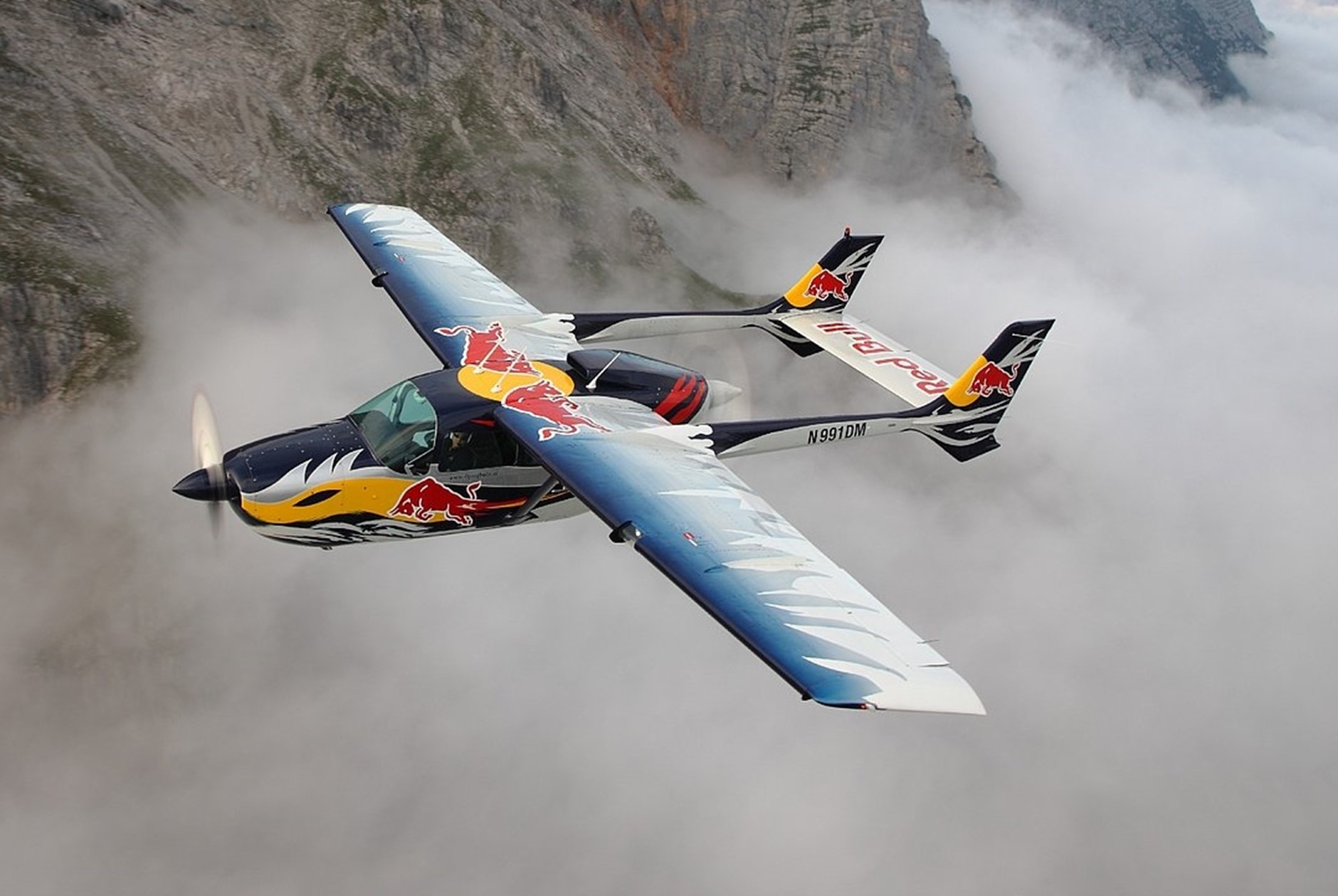

The Cessna C336/7 is unique in that it is the only center-line twin engine civilian aircraft to enter into major production. Hench the arrangement Cessna calls “Push –Pull”.

In the front is an engine with a counter-rotating propeller, and in the rear a second engine with a pusher propeller. Twin booms extend aft of the wings to the vertical stabilizers to the horizontal stabilizer. The advantage of a push-pull configuration, with two air-cooled 210 HP Continental engines, over a classic design, is that if one of the engines fails there is no torque around the vertical axis. Therefore the aircraft remains as controllable as if both engines were working.
During an engine failure, the Skymaster will not yaw toward that engine, as the issue of differential thrust inherent to conventional twin engine aircraft is not applicable.
This also does away with no one-engine-out minimum controllable speed (Vmc).
There is also a drawback, namely that the rear engine can encounter cooling problems.
But the noise is a far more serious problem. The turbulent air pushed by the front propeller meets the air from the rear propeller at a higher speed, thus generating almost supersonic speeds of the prop blade tips.
Thus even non-aviation buffs recognize the Cessna Skymaster with their eyes closed, since its noise rivals even that of the other known Skymaster, the DC-6B.
The noise issue, and also the lesser efficiency at the rear propeller, were reasons why this design was never very popular in civilian use.
Flying a Skymaster still requires a pilot to hold a multi-engine rating.
HISTORY
The first Skymaster, Model 336 Skymaster, had fixed landing gear and initially flew on February 28, 196.
In February 1965, Cessna introduced the Model 337 Super Skymaster.
In 1966, the turbocharged T337 was introduced, and in 1973, the pressurized P337G entered production.
Cessna built 2993 Skymasters of all variants, including 513 military O-2 versions.
Production in America ended in 1982, but was continued by Reims in France, with the FTB337 STOL and the military FTMA “Milirole”.
MILITARY
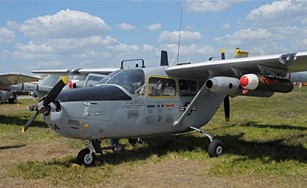
Because of the shoulder wing design, the aircraft allows good visibility for pilot and passengers.
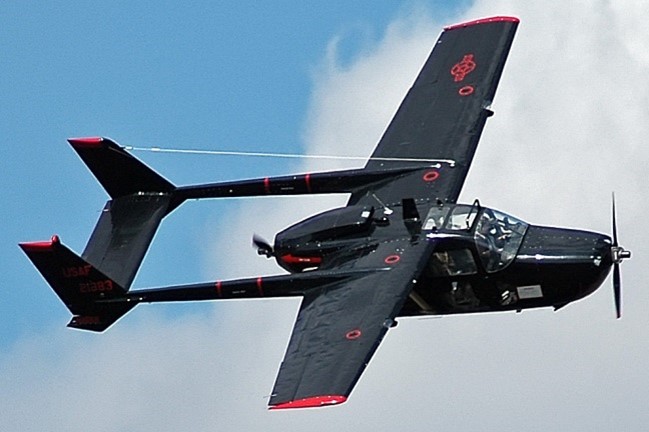
The military thought that these attributes, plus the twin engine design would make it a good military platform.
US military designation for the Skymaster was 337M.
The aircraft were used for Forward Air Control, Observation and Psychological warfare for the US Air Force.
An improved twin turboprop was developed with the same wing, but with new forward fuselage with tandem seating for pilot and observer to give improved view.
The United States Air Force and Army also employed the aircraft in conflicts like Vietnam, fitting it with guns, rockets and yes, loudspeakers.
Other countries like Rhodesia (Zimbabwe) used the aircraft in early warfare during the 1960’and 70’s. Named the Lynx, the aircraft was very successful.
The Imperial Iranian Air Force, Angola, Colombia, Togo, Nicaragua, Burkina Faso, Mozambique, Namibia and other countries used this aircraft in military roles.
BROTHERS TO THE RESCUE
From 1991 until 2001 the Cuban exile group “Hermanos al Rescate” used Skymasters, among other aircraft, to fly search and rescue missions over the Florida Straits looking for people attempting to defect from Cuba. When found, they dropped life-saving supplies to them. Rescues were co-ordinated with the US Coast Guard. They chose Skymasters because their high wing offered better visibility of the waters below, they were reliable and easy to fly for long-duration missions averaging 7 hours. In 1996, two of the Brothers to the Rescue Skymasters were shot down by the Cuban Air Force over international waters. Both aircraft were downed by a MiG-29, while a second jet fighter, a MiG-23 orbited nearby.