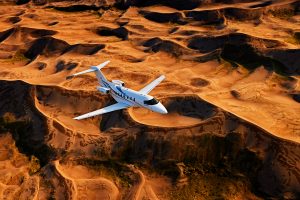
The stall turn is a spectacular manoeuvre to behold and it’s very useful for the aerobatic pilot. It enables the direction of the aircraft to be changed through 180° within a limited amount of airspace and without forfeiting much energy.
Gyroscopic precession and slipstream effect must be understood
The stall turn is a manoeuvre that requires a very good understanding of the gyroscopic precession caused by a rotating propeller when elevator and rudder inputs are made.
The pilot should also have a full understanding of the effect that the helical flow of slipstream from a propeller has on the directional path of an aircraft, particularly at low speed and high power settings.
Unless these phenomena are fully understood, you will never fly a decent stall turn.
This article is based on an aircraft that has a propeller that rotates clockwise as viewed from the cockpit. The manoeuvre is executed to the left as the slipstream effect contributes towards achieving a faster rate of yaw in that direction.
Achieving the vertical climb
We’ve dived down until we have more or less the same speed as for the loop. The wings are level, the “ball” is in the middle and the aircraft is balanced.
A positive pull on the stick is made and, pulling about 3g, the nose pitches towards the canopy. Because of gyroscopic precession, the aircraft tends to yaw slightly to the right and a tiny amount of left rudder counteracts this.
A perfectly vertical flight path is required. The pilot achieves this by using either a sight gauge or by checking that a wingtip is perpendicular to the horizon. The aircraft must not be canted either left or right of the vertical.
During this part of the manoeuvre, the pilot casts their head rapidly left and right to ensure that the position of both wingtips in relation to the horizon is kept exactly the same.
Right rudder is needed on the way up.
During the first few attempts at the stall turn, a pilot usually “drags” the left wing on the way up. The left wingtip will appear to be lower in relation to the horizon, while the right wingtip will appear to be higher. This is because of the slipstream effect becoming progressively more pronounced as the aircraft loses speed.
More and more right rudder has to be applied to prevent the aircraft from travelling upwards with its nose canted to the left. In the pitching plane, care must be taken to ensure that the aircraft is neither short of, nor beyond the vertical.
The turn at the top
The aircraft has now gained significant height and, at the same time, the airspeed has fallen to almost zero. When the climb stops and the aircraft is almost static, full left rudder is applied to yaw the aircraft around its vertical axis through 180° so that it ends up in a vertical dive, going down almost the same path that it was following on the way upwards.
Complications that arise during the turn
Because the aircraft is yawed so rapidly, the right wing, which is on the outside of the turn, will travel faster than the inner wing. It will develop more lift and the aircraft will start rolling left towards an inverted attitude.
Since the engine is operating at full power in this manoeuvre, there will be a definite anti-clockwise torque reaction from the propeller. This means that the tendency of the aircraft to roll to the left is increased. Right aileron must be applied to stop the roll and to keep the wings at 90° to the horizon.
The rapid yaw causes a force that, due to propeller precession, pitches the nose towards the top of the canopy. This can be confirmed by watching the nose traversing from right to left across the horizon. The stick has to be moved forward to stop this movement. If this travel is not stopped, the aircraft will exit the manoeuvre along a different path to the one it had on the entry.
There are, therefore, three distinct control inputs being made during the turn. These are rudder to achieve the turn, aileron to stop the rolling moment, and elevator to stop the aircraft pitching off-line. These control inputs are maintained until the turn is through 180°, at which time they are all centralised.
Not much room for an error
If the wrong elevator and aileron inputs are made at the top of the manoeuvre when full rudder has already been applied and the speed is really low, the potential exists for you to end up in either an upright or an inverted spin.
The recovery
The controls have been centralised and the aircraft is tracking parallel and very close to the path that was flown on the way up. The airspeed is allowed to increase towards what is going to be required for the following manoeuvre and then the aircraft is pulled out of the dive, ready for the further action.
Share:
Facebook
Twitter
Pinterest
LinkedIn



NEWSLETTER
Subscribe to our newsletter for new blog posts, tips and news