The Allied victory in World War Two was a huge combined effort on land, sea and in the air, all coming together to overcome the massive enemy offensive.
Feature Image: Christie’s
Aircraft played a big part, as many of the campaigns would have been impossible without them. Aircraft needed to perform a variety of roles and the biggest of these challenges was ensuring that the engines fitted to these aircraft could reliably take the crews on missions and return them home safely.
Fighters like the Hawker Hurricane and Supermarine Spitfire had one common engine. Fighter Bombers like the de Havilland Mosquito also had the same engine. Additionally large bombers such as the four-engine Avro Lancaster also had the same engine: The Rolls Royce Merlin.
Other aircraft types that used the Merlin were the Handley Page Halifax, the Vickers Wellington II, Fairey Fulmar, Armstrong Whitworth Whitley IV, Boulton Paul Defiant II, Bristol Beaufighter II, Avro York, BOAC Argonaut and the TCA Canadian North Star, to name a few.

History
The first Merlin engine appeared in 1933, and was initially known as the PV-12, with PV standing for ’Private Venture’. Later the engine was named Merlin. Rolls Royce liked to name their engines after birds, thus Merlin came from a northern hemisphere falcon.
Designed as a four-stroke V12 with a carburettor, the first Merlin was flown in a Hawker Hart on 15 October 1933, a biplane used by the RAF. World War II saw rapid improvements in the Merlin to improve performance and increase horsepower.
Originally designed to use an evaporative cooling system, which proved unreliable, the engine was later changed to use ethylene glycol in a conventional liquid-cooling system.
In 1935, the British Air Ministry issued a specification (F10/35) for new fighter aircraft, from where the Spitfire and Hurricanes emerged. The PV-12 was assigned to these aircraft designs, instead of the Rolls Royce Kestrel. In September 1937, K5054, the Spitfire prototype received its first Merlin.
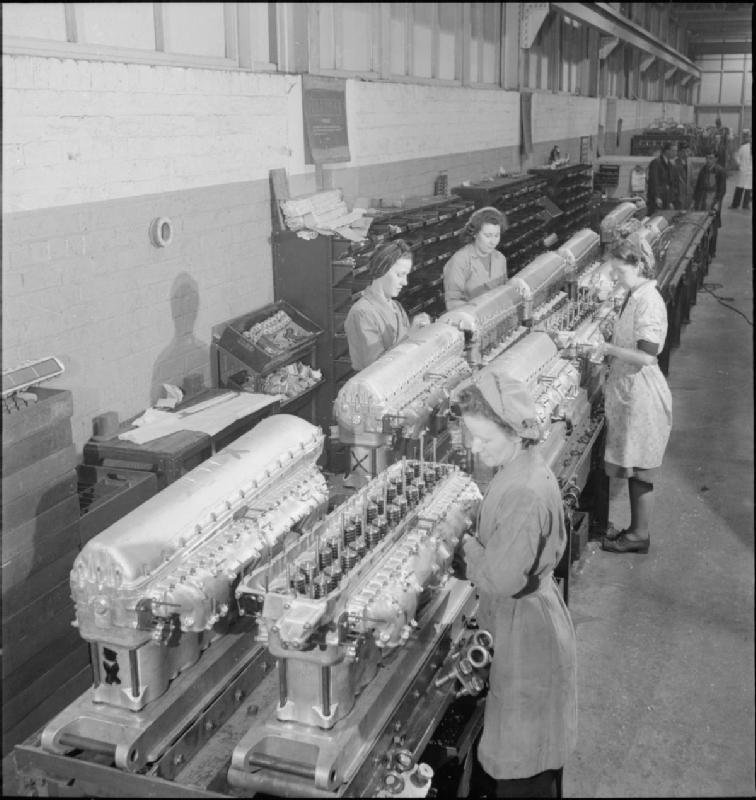
Two more Rolls-Royce engines were developed just prior to the war, the Rolls-Royce Peregrine, and the Rolls Royce Vulture. Although the Peregrine performed satisfactorily, the Vulture suffered from reliability problems and both these engines were later cancelled to enable Rolls Royce to focus on the development and refinement of the Merlin.
Early Merlins suffered from gear train failures and cooling problems, resulting in cylinder head cracking, excessive wear and crankshaft main bearings failures. Camshafts were also an issue.
Success was around the corner, when Rolls-Royce developed the improved Merlin X and Merlin XX. These engines were designed to run on higher octane fuel, allowing higher manifold pressures by increasing the boost from the supercharger.
Cooling problems were finally resolved by the use of a 70/30 percent water-glycol coolant mix rather than the previous 100% glycol of the earlier engines. The supercharger increased power at higher altitudes and reduced the oil leaks that had been a problem with the early Merlin I, II and III series.
Another problem was the Merlin’s float controlled carburettor. If the aircraft was pitched down in negative-g, the temporary fuel starvation caused the engine to cut-out momentarily. This was partially rectified by fitting a restrictor in the fuel supply line together with a diaphragm.
Another improvement was moving the fuel outlet to exactly halfway up the side, allowing the fuel to flow equally well under negative- or positive-g.
Initially the Merlin only produced around 1000 horsepower (750 kW), but later war versions could produce just under 1800 horsepower (1300 kW).
The Americans were very impressed with the engine and under licence to Packard, produced the engine under the designation of the Packard V-1650. These engines were fitted to the North American P-51 Mustang, some Curtiss P-40 and even the Lockheed P-38 Lightning. All these aircraft were originally fitted with the American Allison engine.
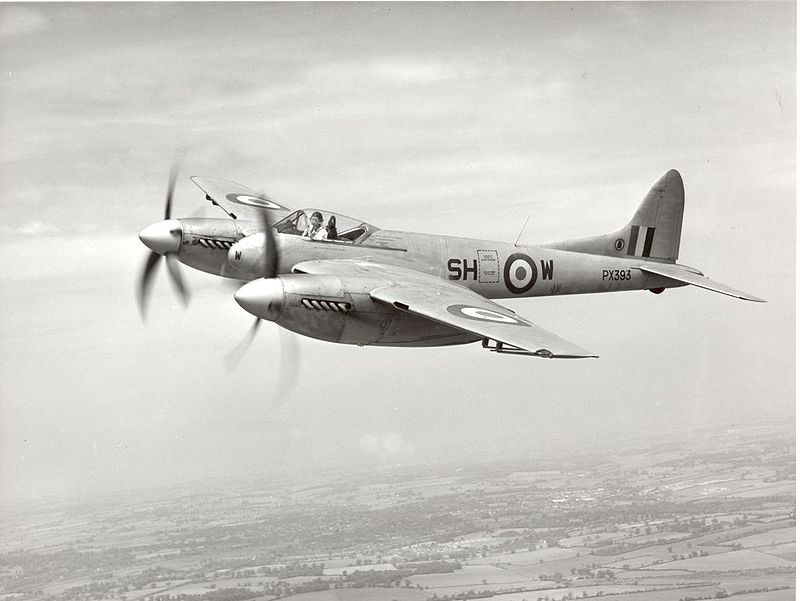
The last version of the Merlin was fitted to the de Havilland Hornet, a carrier based twin engine fighter, producing just over 2000 horsepower (1500 kW). By 1951 the (TBO) time between overhauls was around 650–800 hours.
A little unknown fact is that a de-rated Merlin was produced for the Meteor tank. After the war, many engines were fitted to boats and even in experimental motor vehicles for speed record attempts.
Production of the Merlin ceased in 1950, after demand started to dry up, as new jet turbine engines were now the norm and being fitted to fighters, bombers and airliners. The Merlin engine was superseded by the Rolls-Royce Griffon engine.
Almost 150 000 Merlin engines were built.
Today the Merlin is still widely used in historic aircraft worldwide under private ownership and by the RAF with the ‘Battle of Britain Memorial Flight’ for their Lancasters, Spitfires and Hurricanes.