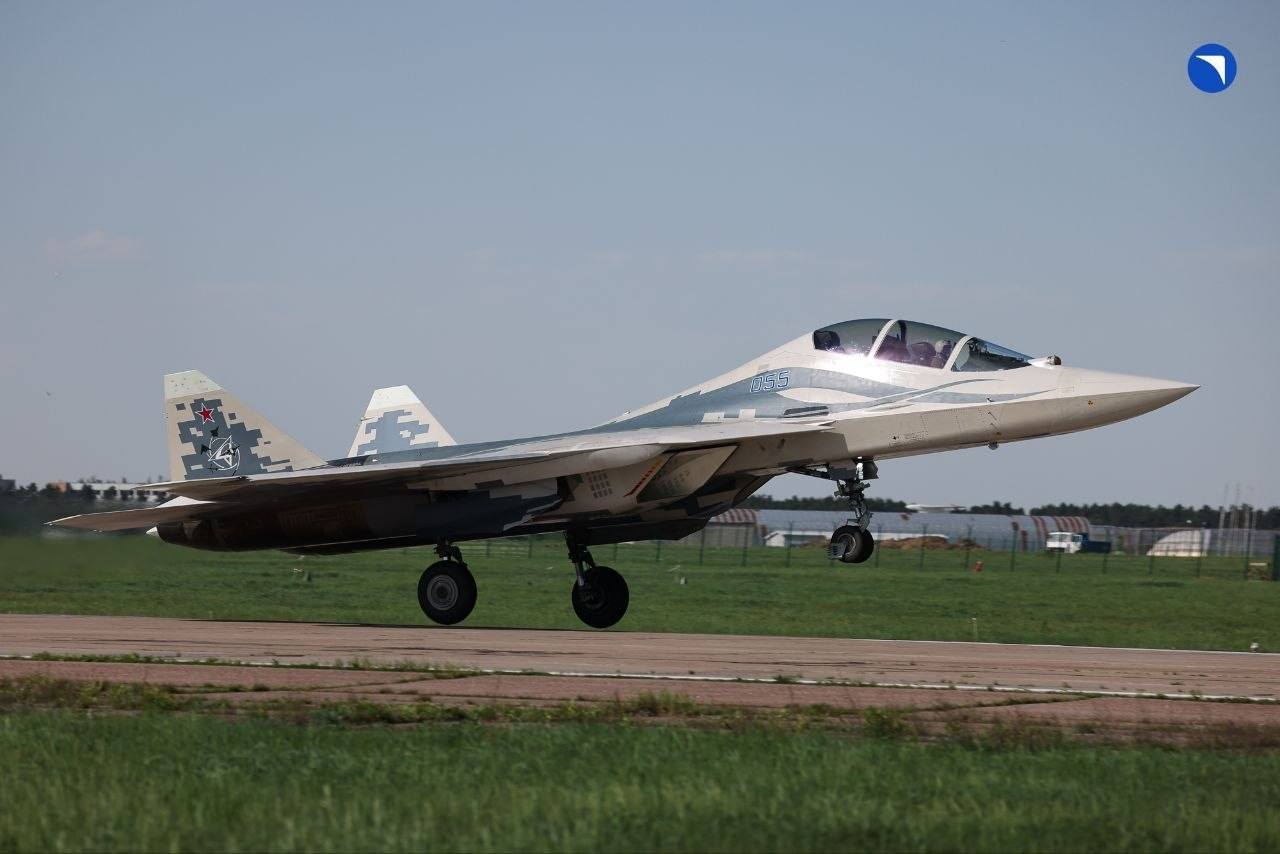
Russia has announced that a two-seat variant of its fifth-generation Su-57 stealth fighter has successfully completed a test flight, marking the first official confirmation that the aircraft has moved beyond the design and patent stage. The development was confirmed by Russian First Deputy Prime Minister Denis Manturov in comments carried by Russian state media.
According to Manturov, the new aircraft has been designed not only as a combat platform but also as a training and airborne command aircraft capable of coordinating unmanned systems during operations.
“This aircraft, developed proactively by our aircraft manufacturers, will not only boast unique combat capabilities but also the functionality of a combat training aircraft and the capabilities of a combat control aircraft,” Manturov stated.
The new variant has reportedly been designated the Su-57D, differentiating it from the baseline Su-57 as well as the export-focused Su-57E model that has appeared at international defence exhibitions in recent years.
The existence of the two-seat configuration first emerged publicly in late 2023 when a patent filed by United Aircraft Corporation surfaced online. The patent outlined the aircraft’s revised internal arrangement and broader mission set including its potential use as an aerial command platform capable of coordinating and controlling unmanned aerial vehicles during combat missions.
Russian documentation associated with the patent suggested the aircraft could direct UAVs carrying bombs or other precision-guided munitions while also functioning in a command-and-control role for manned and unmanned teaming operations. This concept mirrors growing global trends toward integrating fighter aircraft with autonomous or semi-autonomous “loyal wingman” drones.
Interestingly, the patent reportedly compared the new aircraft more closely to the twin-seat Su-30MK export fighter than to the single-seat Su-57 itself despite the aircraft sharing the same basic stealth airframe and systems architecture.
The Su-57 programme has faced years of delays, production bottlenecks and limited export success since its inception. However, Russian officials have increasingly promoted the aircraft internationally amid growing interest from countries seeking alternatives to Western fighter platforms.
In April, Russia claimed that contracts had been signed with several countries for export versions of the Su-57E although Algeria remains the only widely identified foreign customer according to defence observers.
The introduction of a two-seat Su-57D could significantly expand the aircraft’s export appeal particularly for air forces seeking advanced strike, command and drone-control capabilities combined with an operational conversion trainer. Twin-seat fighters traditionally remain attractive to export customers because they simplify pilot transition training while also enabling complex mission coordination.
The aircraft’s potential role as a drone controller is especially notable given the growing importance of unmanned systems in modern warfare. Russia has increasingly emphasised manned-unmanned teaming concepts following lessons learned from ongoing conflicts and the rapid evolution of UAV technologies worldwide.
Although Russia has now confirmed a successful test flight, few technical details regarding the Su-57D’s performance, avionics changes or production timeline have been released publicly. Images of the aircraft have also not yet been officially published.
The development nevertheless signals Russia’s continued effort to modernise and diversify the Su-57 platform while strengthening its position in the increasingly competitive global fighter export market.