The atmosphere is best described as dark and melodramatic. I am 500ft above the ground, skimming a few metres below a solid overcast, which is blocking out much of the early morning light, but I am not concerned.
By Elton Bondi
I have a clear flat horizon, the air is stable, and there are no hills or rising ground for the next 2hrs when I will arrive at my next destination; besides its just after dawn, and the overcast is already lifting, it will burn off completely within a few hours. But for now, these are unusual ‘moody’ conditions, and I am in an unusual airplane.
I am flying a big single seat, all metal, mid-wing monoplane. Although I am perched relatively high under a fighter like bubble canopy, I still cannot see over or around the massive radial engine, growling away upfront spewing oil mist over the windscreen, fuselage and wing roots. Staring at the massive wing, I marvel at the hundreds of strengthening corrugations and oversized rivets that hold this flying ironmongery together, there is no streamlined subtly here, this airplane is built military strong, and it feels like I am flying a bridge.
Because I have a long distance to travel and not much fuel, I am flying grossly “oversquare” with the throttle at full bore, and the engine RPM dialed all the way back to under 1800rpm. Most of the more modern airplanes I fly would not allow this, but this manufacturer recommends it for long range flying. Save for the melodic vibration from the radial engine, making the instrument needles shake and dance in unified rhythm, all else is very still in the spartan military like cockpit.
Despite packing many cushions both under and behind me, the positioning of the stick is still so far forward that I cannot rest my right arm on my knee while holding onto the stick grip. So, I have to hold my arm up like I am carrying an Olympic flame, not comfortable for long distance flying in an airplane with no trim tabs.
But I am smiling, relishing the experience, this is very different to what I am used to flying. Then suddenly, unbelievably, I notice a few subtle puffs of white smoke coming from the left of the engine and streaking past the canopy. Did I see that right? I look again, yes there definitely is smoke!
My bliss is immediately replaced by worry, my grin transformed to raised eyebrows, wide eyes, and a dry mouth. My shaking hands now match the trembling needles. I am experiencing that horrible mix of disbelief and fear, as I scan the sparse monochrome instrument panel to find a cause; temperatures, pressures, and flows are all normal, so why the smoke? – Darn! was hoping for an unremarkable day – a quick scan of my map shows that there is no runway for at least 30mins flying.
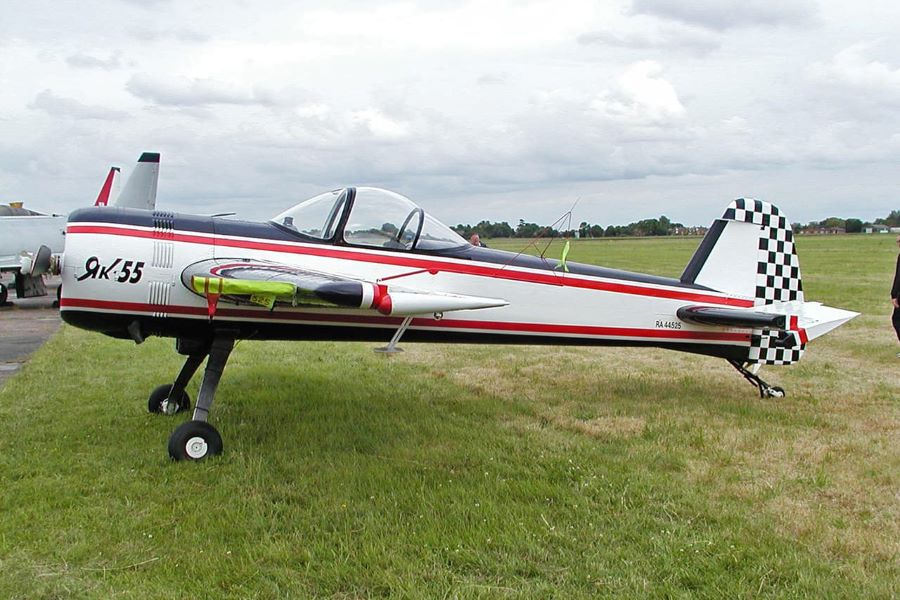
No, it’s not 1944 and I am not in some Second World War US Navy radial engine fighter flying over the South Pacific nursing a battle-damaged aircraft back to my carrier. Quite the opposite, I am flying a Soviet era aerobatic airplane, (their best of breed in the 1980’s). The year is 2019 and I am flying over the arid Southeastern edge of the Kalahari Desert, ferrying the magnificent Yak 55 from Johannesburg to Cape Town.
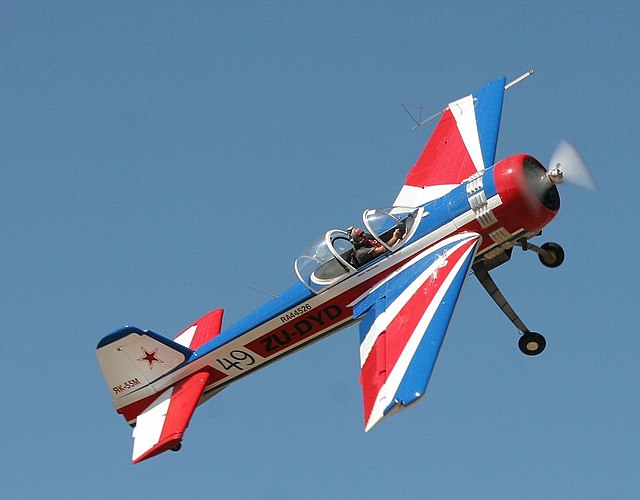
The Soviet state-controlled aircraft manufacturer Yakovlev (Yak) is no stranger to high performance single seat aircraft. They built a range of potent Second World War fighters (Yak3 and Yak 9 being the most celebrated and effective variants). After the war Yak went on to build a successful tandem seat military trainer based on the ubiquitous 360hp Vedeneyev M14P radial engine; the famous Yak 52, which became the standard cold war eastern bloc trainer for several decades.
Yakovlev also built several single seat aircraft, designed for aerobatic competition, the Yak 18PS and Yak 50 were two triumphant types that allowed the Russian team to dominate the sport during the 1950s and 60s. Although these were single seat competition hotrods, these aircraft we were similar to the early Yak primary trainers.
The Yak 55 followed in the early 1980s, and it was different because it was a clean sheet design. All it shared with its military trainer forbearers was its name, Yakovlev’s experience with building airplanes using metal, and the big radial engine.
From its inception the Yak 55 was a winner, it is about as symmetrical as an airplane can get, which makes sense for an airplane that will spend half its life inverted. The fuselage cross section is symmetrical, the fully symmetrical mid wing is placed precisely in the centre of the fuselage, there is no dihedral and no angle of incidence. All that differentiates the top of the airplane from the bottom is the fact that an undercarriage sticks out from the bottom, and a canopy, fin and rudder protrude out the top. Take these away and the airplane is almost perfectly symmetrical.
For a single seat aerobatic aircraft its very big, very greasy and scary, as in “military grade” daunting. The trailing edge of the wing comes up to my sternum (and for those that know me I’m a tall person, but not that tall 😉); yet there is no step to climb up. To get into the cockpit you must face the tail, put your right hand on the wing trailing edge, your left on the fuselage behind the cockpit and somehow jump-launch-pull yourself up onto the wing. It’s not easy, and always amusing to watch a new pilot try get in one. Get it wrong and you can fall onto your face.
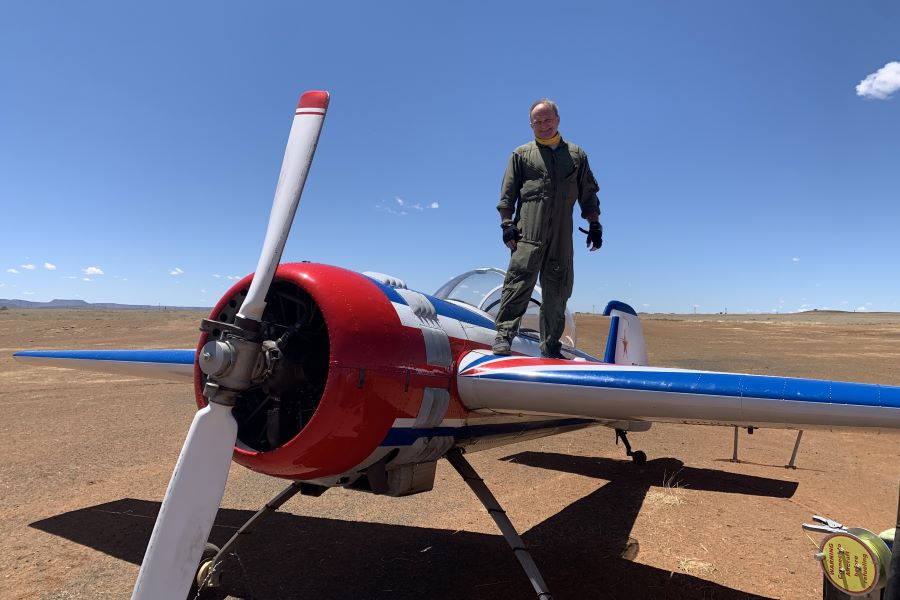
The Yak 55 is certainly an intimidating aircraft from any perspective, that is until you fly it, I’ll discuss flying it in the next article.
…. And what about the engine smoke? Well, even though all instrument readings were normal, and the engine sounded fine, I was still not going to take chances. White smoke means oil is burning, probably leaking onto a hot exhaust (that is after all how we make white airshow smoke); and if there is an oil leak, then that means this engine will soon bleed to death and seize, if it doesn’t catch fire before then.
I resigned myself to the fact that I was not going to make my destination, but I was over flat terrain, and I took comfort in the knowledge that if I focus this should not hurt at all. And so, if going to have to land, then I was at least going to do it on my terms, and not wait for the engine to quit. I saw a long gravel road, made a radio call, tightened my straps, throttled back and set up for a landing, there were no power lines and my confidence was growing, and I thought maybe I might even save the airplane.
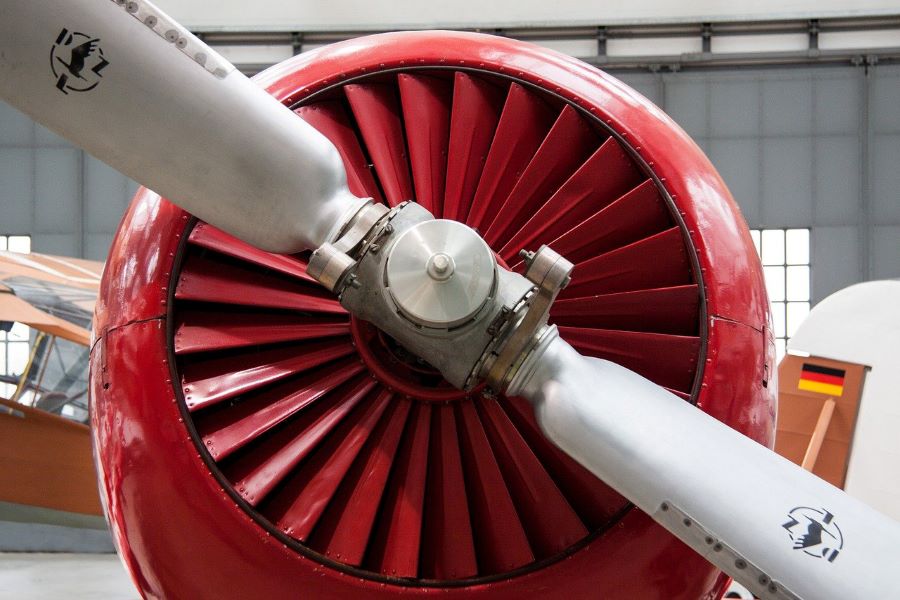
Road camber was my next concern, would I be able to keep it on the narrow road? But as I descended the ‘smoke’ stopped, that’s strange? I opened the power and then throttled back again, still no smoke. Then it dawned on me. There never was burning smoke, the white puffs were puffs of moisture (in effect mini clouds) formed from propeller tip vortices being thrown back from the huge paddle propeller flying in very humid air just below the clouds.
Fly at below 1800rpm near cloud and you’ll get that. I climbed back up to 500’ made an embarrassing “I’m sorry please disregard last” radio call and carried on ferrying my make believe F6F Hellcat back to my aircraft carrier somewhere in the Pacific.
In the next article I’ll describe flying Mr Jack Double Nickel or as the Soviets say the Yak55.