In November 80 years ago Howard Hughes’s folly took to the skies for a very short maiden and only flight to make history books.
It was 1942, and he Second World War was raging. The United States needed to get men and supplies across the Atlantic, but the passage was extremely dangerous with thousands of allied ships being menaced by German U-boats.
The idea for the aircraft was conceived in the early 1940’s by industrialist Henry J. Kaiser, (a major ship builder) and was designed and built in partnership by famed Hollywood producer, tool empire millionaire, and aircraft fanatic, Howard Hughes.

It was designed to carry as many as 750 fully equipped soldiers on transoceanic flights. As with the famous de Havilland DH.98 Mosquito fighter-bomber, the aircraft was to be built using 90% wood, which would have freed up valuable metal alloys when the aircraft was in production.
The 1942 US government contract required three aircraft to be constructed for transport use within three years. The development process was going slowly and construction of the aircraft did not begin until 16 months after the contract was awarded.
The original plan for the aircraft was to have huge clam shell doors in the nose, which not uncommon in large transport aircraft that were starting to be used during World War Two such as the Me-323 Gigant, and the later Douglas C124 Globemaster II.
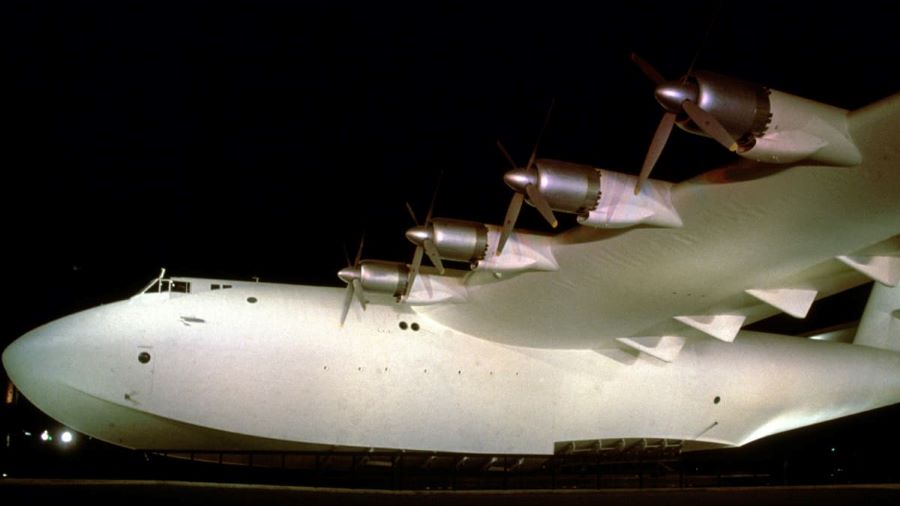
Hughes was worried though that in the event of an accident the mighty flying boat could fill with water through those doors and sink. So he re-designed the aircraft to have a solid nose and came up with a rather unique (and unusual) method to increase the buoyancy of the H-4 by filling the void spaces in the lower hull and wing floats with inflatable bladders and beach balls.
The aircraft was initially called the HK-1, for Hughes-Kaiser, but when Kaiser withdrew from the project in 1944, blaming the slow progress and ongoing strategic materials restrictions needed, it was re-designated the H-4 Hercules.
The media ended up calling it “The Spruce Goose”, a name Howard Hughes disliked immensely. Ironically “The Spruce Goose” was mainly built from birch wood, not spruce.
On 2 November 1947, Howard Hughes’s Hughes Aircraft Company H-4 Hercules flying boat, NX37602, made its first and only flight at the harbour of Los Angeles, California, with Howard Hughes at the controls. Hughes was accused of war profiteering and, perhaps out of spite, finished and even flew the H-4 just to prove to the world that the effort was not in vain. Hence, it only flew once and only for 26 seconds for approximately one mile (1.6 kilometres) at 135 miles per hour (217 kilometres per hour), remaining in ground effect above the water.
After the flight, the aircraft remained in airworthy condition and lived in a climate-controlled Long Beach hangar until Hughes’s death in 1976. In the ’90s, the H-4 made one last unpowered trip over water and land to its permanent home not far from Portland, Oregon, to the Evergreen Aviation and Space Museum, McMinnville, Oregon. The cost for maintenance exceeding USD1 million per year.
SPECIFICATIONS
The H-4 is 218 feet, 8 inches (66.650 metres) long with a wingspan of 320 feet, 11 inches (97.815 metres). Its height is 79 feet, 4 inches (24.181 metres). The Hercules’s designed loaded weight is 400,000 pounds (181,437 kilograms).
Powered was by eight air-cooled, supercharged 4,362.49-cubic-inch-displacement (71.489 litre) Pratt & Whitney Wasp Major VSB11-G (R-4360-4A) four-row 28-cylinder radial engines. This engine had a Normal Power rating of 2,500 horsepower at 2,550 rpm. to 5,000 feet (1,524 metres). However at 14,500 feet (4,420 metres), the power dropped off considerably to only 2,200 horsepower.
Take-off and military power rating was 3,000 horsepower at 2,700 rpm. for a few short minutes.
H-4 RECORDS
- The largest flying boat ever built.
- The largest wooden aircraft ever built.
- The largest aircraft in the world by wingspan only of 97.5 metres.
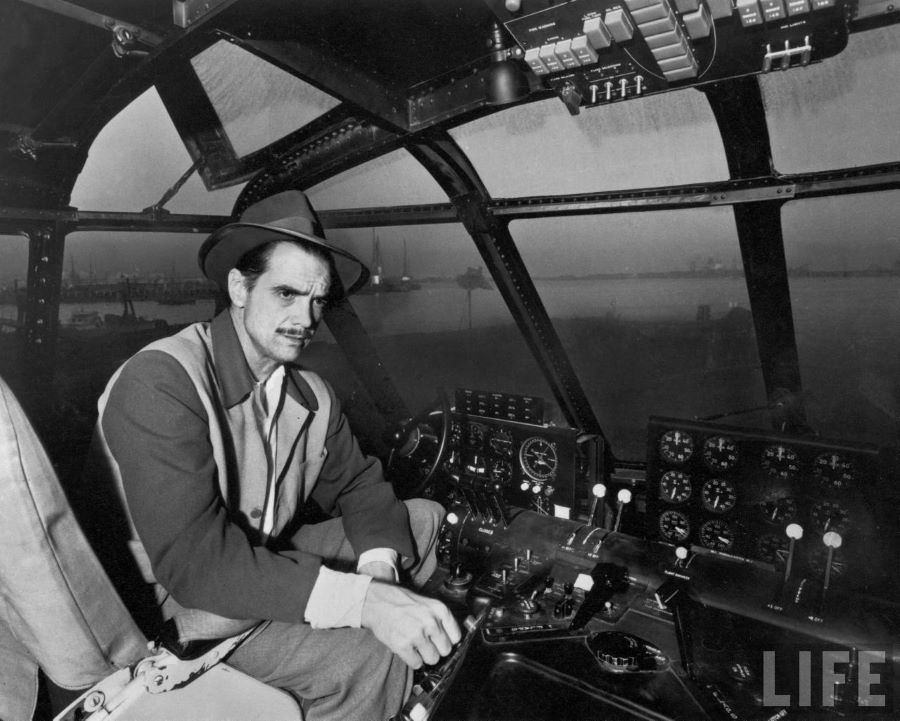
Even now, over 80 years since its first and last flight, the aircraft is an amazing sight to see and you are allowed to go inside and sit in the pilot seat that Howard Hughes used on that day in November.