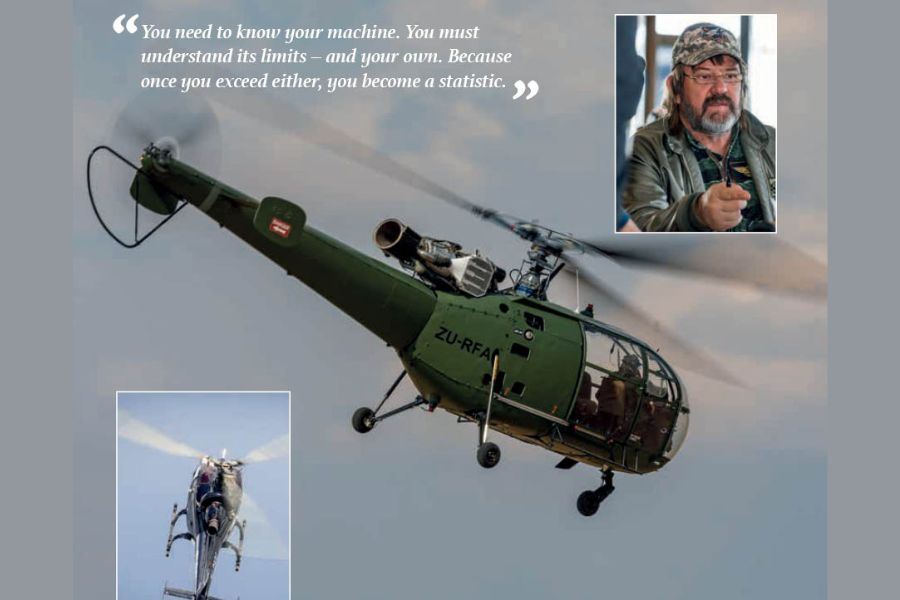

In a world of soaring machines and highspeed display lines, few names carry the weight of Juba.
Known across the African continent for his daring rotorcraft displays and even more so for his shadowy past flying in wartorn skies, Juba has lived an aviation life on the edge – and survived to tell the tale. For over 20 years, he’s been part of the South African airshow
landscape – flying low, tight and with unmistakable presence. But behind the smoke trails and crowd-pleasing turns lies a history that
reads like a Cold War novel: Soviet helicopters, African warzones, private military contractors and combat flights where the rules didn’t
exist – only survival. Now, as Smoke On Go marks two decades of airshow celebration, Juba reflects on what shaped him: the formative moments of his display career, the pain of loss and the mission to prepare a new generation for a future in the skies.
Where were you in your aviation journey back in 2005?
I was nowhere near the display circuit. I was flying in some of Africa’s harshest warzones – Angola, Sierra Leone – as part of a private military contract operation. I started working with Executive Outcomes in the 90s. By 2005, I was flying big Russian helicopters like the MI-17 and MI-24. Let me tell you, converting onto those machines wasn’t formal. They gave us 15 minutes. That’s it. One circuit. Then you were solo – inside a 12-ton monster written in Cyrillic, with Natasha speaking Russian in your headset. We learned as we flew.
And we flew into fire. I got shot down by a missile once. Survived. That changes your relationship with flight. Suddenly, every movement matters.
Juba, what were the five most defining moments of your airshow career?
Bobro Tsoano, back in the early days. I was flying the BK117 and the PC-7 there. It was magic. That aircraft just… dances in the air when you treat her right. Virginia was another highlight – especially last year. The wind was howling, most of the fixed-wing guys were grounded or cautious, but I could go up. Crowds were close, atmosphere electric, and I love the challenge. It’s not just about showing off – it’s about adapting. That’s the art. AAD 2022 was memorable for the opposite reason: terrible weather. Clouds low, wind biting, and yet – I still managed to fly. You can’t go vertical, but if you understand your rotor disk and your machine, you can still impress. Then there was Nelspruit – the first time I flew the Gazelle. Man, that aircraft is like a scalpel in the sky. Agile, quick, elegant. I’ve fallen in love with it. And lastly, Stellenbosch. Flying through the clouds, against the backdrop of mountains and vineyards – it felt like theatre. It was one of those spiritual flying moments that stay with you.
Who helped shape you as a pilot?
In the Air Force, my instructors – Sarel Ceronio and Eddie Brown. Eddie was razorsharp. Precision was everything. But the truth? My biggest lessons came outside the rulebook. In combat zones, there were no SOPs. Just you, the machine, and the threat. You learn quickly what the limits are – and when you can push them. That edge, that sharpness… it saved my life. But you don’t get there alone. You need instructors who’ve seen it all. Good training is gold.
What advice would you give your 2005 self?
Invest in relationships – and sponsors. Helicopters are expensive. That’s the biggest hurdle in airshows. And more than anything: train, train, train. Fly with those who are better than you. Learn from their mistakes before you make your own.
What should change about the South African airshow scene over the next 20 years?
We need to bring in the next generation. Right now, I’m building a 12-ship helicopter formation for the Nelspruit Airshow. It’s tough – heli formation is a beast of its own. You don’t just “fall in.” You need finesse, awareness, discipline. But it’s worth it. Helicopters are the underdog of airshows. When flown right, they blow people’s minds. I want to build that excitement – and pass it on.
Is there a pilot you still miss? One we’ve lost along the way?
Far too many. Roommates, friends, mentors. Some died in war. Some in accidents that shouldn’t have happened. That’s why I’m critical. I push people hard. Because I’ve seen how small mistakes end careers – or lives. And when it happens in this world, it hits the whole community. We have to be better. Not just skilled – but wise.
Share:
Facebook
Twitter
Pinterest
LinkedIn



NEWSLETTER
Subscribe to our newsletter for new blog posts, tips and news