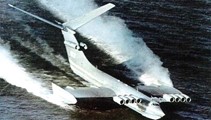
The secret Soviet KM project was discovered by the United States in 1967, when photographs taken from spy satellites showed this aircraft taxing during testing near Kaspiysk. The strange aircraft puzzled intelligence agencies in the West.
The United States Central Intelligence Agency (CIA) branded the aircraft the “Kaspian Monster” after the KM markings on the fuselage. Later it became known as the “Caspian Sea Monster”, but “KM” actually stood for Корабль-макет meaning “Prototype ship” in Russian.
With the small stubby wings despite its large size, the KM was initially assumed to be an unfinished conventional aircraft, but it was quickly determined that the vehicle could not fly high at all.
HISTORY
On June 22, 1966, the completed KM began transportation along the Volga River to the testing grounds on the Caspian Sea near the town of Kaspiysk. It was transported from Gorky along the river in secret, covered in camouflage and moving only at night. The aircraft’s first flight was on October 16, 1966, performed by Vladimir Loginov and Rostislav Alexeyev himself, which was very unusual as most Soviet aircraft designers never piloted their own creations. All the work was conducted under patronage of the Ministry of Shipbuilding Industry. Testing showed the KM to have an optimum (fuel efficient) cruising speed of 430 km/h (267 mph, 232 knots), and a maximum operational speed of 500 km/h (311 mph, 270 knots). The maximum speed achieved was 650 km/h (404 mph, 350 knots), although some sources claim up to 740 km/h (460 mph, 400 knots).
The KM was at first seen as a promising vehicle specialized for use by military and rescue workers but its design caused many difficulties; progress slowed and Alexeyev moved on to other ekranoplan projects. It was tested on the Caspian Sea for 15 years until 1980, when it was destroyed following a crash caused by pilot error.
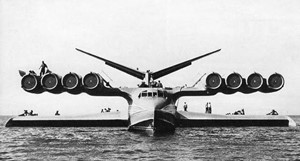
There were no human casualties, but the KM was damaged and no attempts were made to save it, being left to float before eventually sinking a week later. The KM was deemed too heavy to recover and has remained underwater at the crash site ever since, with no plans to build another.
The KM later became the basis for the Lun-class Ekranoplan developed by the Central Hydrofoil Design Bureau in the 1980s, which saw one example, the MD-160, enter service with the Soviet Navy and later the Russian Navy.
The development of ground effect vehicles has not been as widespread in the West as in the Soviet Union. The KM was an experimental aircraft developed during a time when the Soviet Union saw interest in ground effect vehicles (aircraft-like vehicles that use ground effect), to fly several meters above surfaces, primarily bodies of water.
Designed at the Central Hydrofoil Design Bureau, by the chief designer Rostislav Alexeyev and the lead engineer V. Efimov, and manufactured at the Red Sormovo plant in Gorky (now Nizhny Novgorod). The KM was among the earliest major Ekranoplan projects and was notable for its massive size and payload, becoming the largest aircraft in the world when it was completed in 1966, and remained the largest aircraft in the world during the entirety of its existence and is the second-largest aircraft ever built.
SPECIFICATIONS
- Wingspan: 37.6 metres (123 ft.)
- Length: 92 m (302 ft.)
- Maximum Takeoff Weight: 544 tonnes.
- Altitude: 5–10 metres (16–33 ft.)
The KM was also undetectable to many radar systems, as it flew below the minimum altitude of detection. Despite technically being an aircraft, it was considered by the authorities to be closer to a boat and was assigned to the Soviet Navy, but operated by test pilots of the Soviet Air Forces.
Noteworthy is that the KM was documented as a marine vessel and prior to the first flight a bottle of champagne was broken against its nose, a tradition for the first voyage of a watercraft.
THE PRESENT
Ground effect vehicles have made a major resurgence in the last decade, with many examples now being marketed.
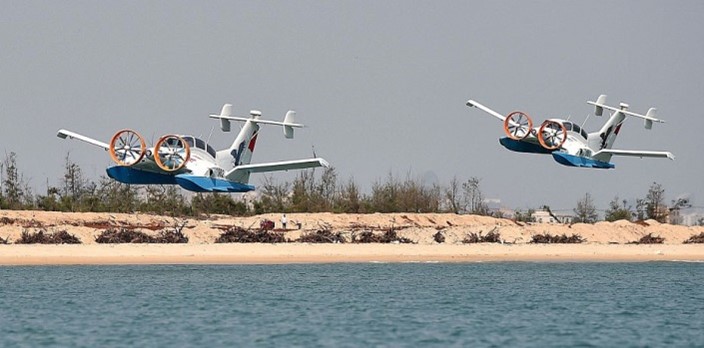
The Chinese CYG-11. 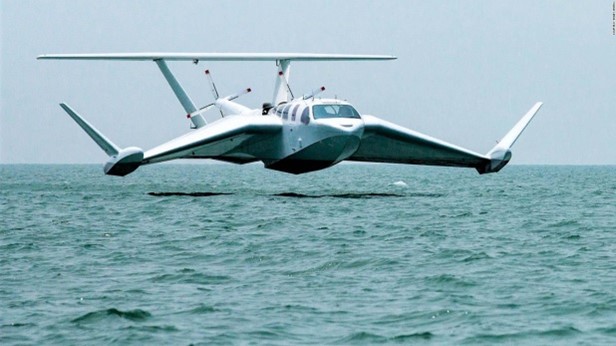
The Wigitworks Airfish.
Even the Chinese are using this technology using the CYG-11. This craft can reach speeds of 250km/h and boasts a maximum range of 1500Km. This particular craft seats 12 people, and can take a load of 1.2 tonnes, cruising 3 to 5 meters above the wavetops.
The Airfish-8 is designed to be operated by two crew in standard civilian transport configuration carrying 6-8 passengers. The craft is powered by a compact V8 car engine driving two propellers.
THE FUTURE
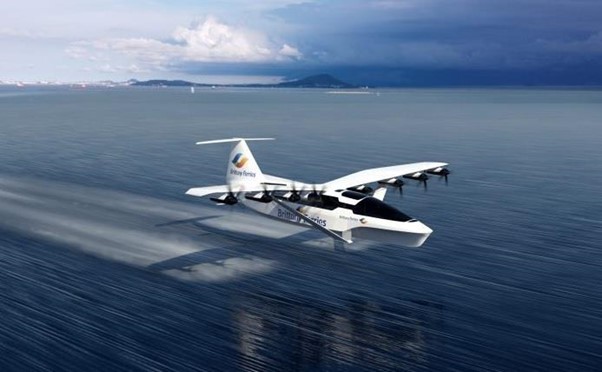
The US Boston based company Regent is now building an Electric ground effect vehicle capable of flying 180 miles at 180km/h. To date they have taken orders to the value of US$465 million. The SEAGLIDER will be powered by eight propellers. Well-known Brittany Ferries has shown interest in using this mode of transport carrying 19 passengers, with future models taking as much as 50 passengers.