
‘THE FLYING LIONS’ AEROBATIC TEAM
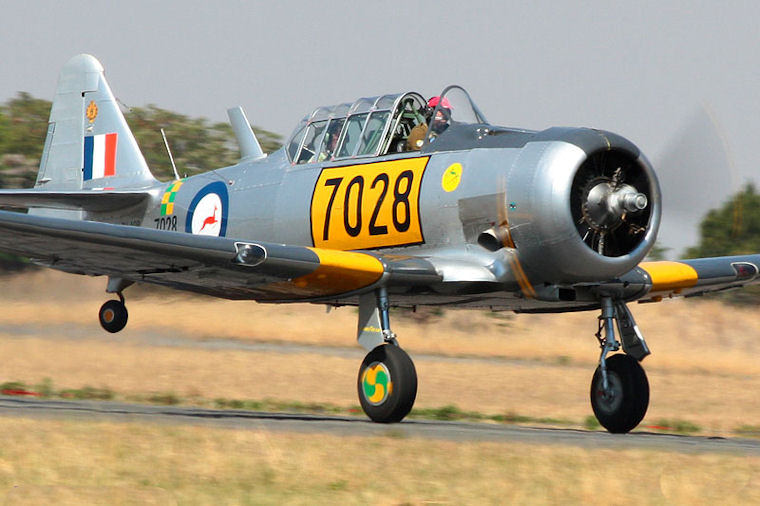
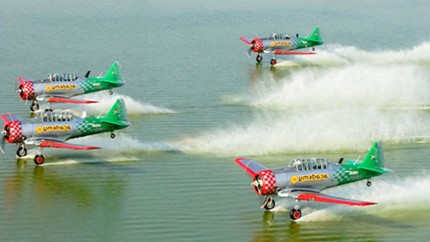
The Flying Lions Aerobatic Team is a well-known South African formation aerobatic team. They fly a four-ship aerobatic display using the Harvard. The team operates five aircraft but only uses four in their displays, leaving the fifth to be used as a backup. The Flying Lions have been in operation since 1999 when Arnie Meneghelli acquired Harvard aircraft that the Air Force was decommissioning. The Flying Lions participate at many major airshows around South Africa.
Pilot’s are Scully Levin, Ellis Levin, Arnie Meneghelli, Sean Thackwray, Steward Lithgow (RIP Dec 3, 2019).
The Team is currently sponsored by Eqstra Holdings Ltd. Past sponsors include: Academy Brushware, Air BP, Castrol, Cell C, Nissan and Peugot.
Wonderboom Airport also has a number of Harvards under a private collector.
HARVARD CLUB OF SOUTH AFRICA
The idea of a Harvard Club originated in The South African Air Force (SAAFA) during 1988-89. The aim was to recruit members for SAAFA by grouping together airmen involved with the North American Harvard since 1940. The Club was officially launched at Central Flying School (CFS) Dunnottar in 1990, during the Harvard 50th anniversary celebrations, in which the SAAF managed to fly a 50 aircraft formation of Harvards.
The ‘Harvard Club of South Africa’ operates a number of ex-SAAF Harvards.
The first three Harvards were officially handed over to the chairman during a function held at AFB Swartkop in 1994. Harvards 7028, 7512 and 7643 were flown over to Jan Smuts International Airport where SAA Technical carried out the inspections and re-registered the aircraft on the civilian register.
Eleven registrations ZU-AOO to ZU-AOZ were reserved for the Harvard Club. During 1994/1995 the other 7 aircraft were delivered.
MOVIES
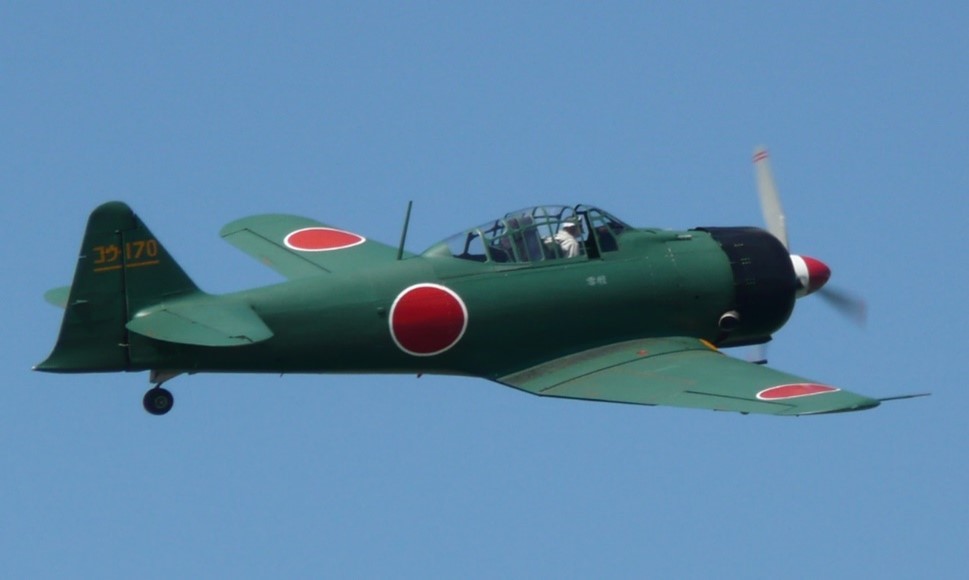
Besides these aircraft starring in movies in their original form, many have been converted into replicas of warbirds with the best known conversions for the 1970 movie ‘TORA TORA’. The movie script required Japanese aircraft in a war film that dramatizes the Japanese attack on Pearl Harbour 1941. The last famous example of modified T-6’S used as warbirds was in the 2001 movie ‘PEARL HARBOUR’.
- Mitsubishi A6M Zero fighter Replica: The modifications required a new windshield and upper deck. The conversion team enlarged the engine cowling, reshaped the Texan’s wing tips, a retractable BT-13 tail wheel, landing gear doors and a fiberglass addition to the wing’s leading edge hiding the distinctive shape of the AT-6’s landing gear wheel wells. The rudder profile was reshaped, a rather large spinner over the AT-6’s normally bare propeller hub and finally added simulated machine gun ports to the cowling and wing-mounted cannons to complete the lethal look. Twenty five replica Zero’s were built.
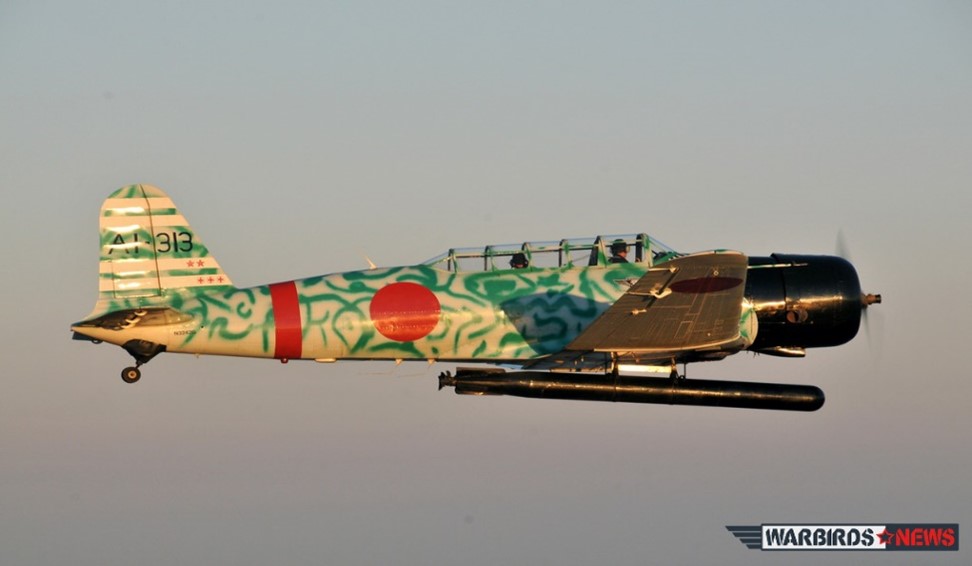
- Nakajima Kate B5N replica: A real Kate has a very long fuselage that houses a three-place cockpit area. The front end was a T-6 airframe with a custom-built 6’11” fuselage extension coupled to the tail unit from a BT-13 with a reshaped, more Kate-like fin and rudder.
The modifications also included a completely new, five-section greenhouse canopy with a rearwards facing seat for the tail gunner, and finally a belly-mounted fiberglass torpedo.
Nine Kates were built.
- Aicha D3A Type Val type 99 dive bomber replica: The replica Val required the most extensive modifications with a new engine, propeller and extensive changes to the fuselage shape, cockpit, wing and tail.
Nine Vals were also built.
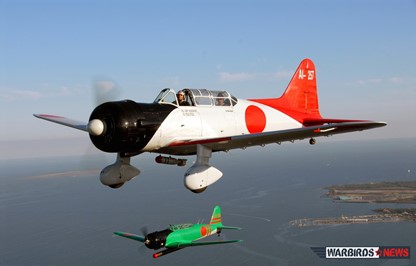
Stewart-Davis and Cal-Volair built all the above aircraft. A few of each type had three-bladed props, gear-cased engines and tail hooks fitted for close-up scenes and carrier landings. In addition, Kawasaki Aircraft modified nineteen further T-6s in Japan using the “California pattern” for second unit filming in that country. Tragically, Jack Canary was not there to see his “Fox Air Force” become a reality. He died in August 1968 while flying one of the Valiants to California for conversion. Interestingly, the production company filmed footage of the Japanese replicas taking off for the raid using the USS Yorktown (CVS-10) as a substitute for one of the six Japanese aircraft carriers in the attack. The carrier herself was a veteran WWII aircraft carrier.
At the conclusion of filming, some of the aircraft returned to their original configuration, but most remained as they were for the movie. Of these, the production company donated four Zero’s, a Val and a Kate to the Confederate Air Force (CAF) in October 1971.
BACON SUPER T-6
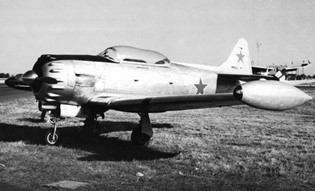
The Bacon Super T-6 was a North American T-6F Texan that was modified during the mid 1950s by the Erle L. Bacon Corporation in an attempt to interest foreign air forces in an upgrade for their T-6 fleets.
Significant additions included a nose wheel and wing tip tanks. The aircraft did not receive sufficient interest for production, and only the single conversion was produced.
SHELL SUPER T-6 fighter replica
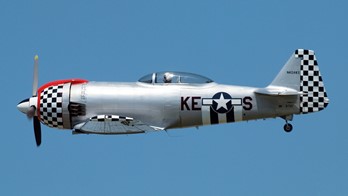
After the death of his son John Shell Jr., John Shell Sr. finished the build of the aircraft as a tribute to his son.
Major modifications included a larger engine and moving the cockpit rearwards with a clear canopy.
The aircraft performed at various airshows. Many have said that on appearance the aircraft looked like a cross between a T-6 and a WWII P-47 Thunderbolt fighter. In part this could have been because of the aircrafts colour scheme and the large radial engine..
Unfortunately due to mechanical issues in 2017, John Shell Sr. crashed the aircraft shortly after takeoff on Feb 6th. The aircraft burnt out, and Shell (84 years old at the time) escaped with minor injuries.
LAST OF THE T-6’s
In April 1951, the USAF ordered an additional 107 T-6Gs, designated NA-188. In March 1952, they again placed an order for 11 training aircraft, designated NA-195, and then a final batch of 110 aircraft in June, designated NA-197.
Today, over 600 T-6 Texans remain in airworthy condition. Most of the former “hacks” are based in North America and are a reminder of the importance of simplicity in training and function.
A total of 15,495 aircraft were manufactured.