
With the ending of the Second World War, the recently expanded aircraft manufacturing industry was duly concerned. Orders and contracts for military aircraft manufacturing dried up almost immediately, and manufacturers needed to be innovative to survive.
One such company, de Havilland Aircraft of Canada Ltd, was interested in developing its own aircraft designs, and chose to focus on producing a contemporary aircraft for pilot training.
The de Havilland Tiger Moth biplane which had been produced by the thousands before and during the Second World War was obsolete and needed a successor.
A Polish engineer Wsiewolod Jakimiuk led the design team of the new aircraft.
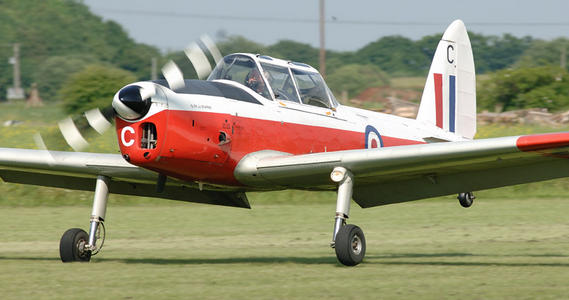
The new aircraft was a cantilever, fixed gear monoplane that incorporated numerous advances like an enclosed cockpit complete with a rear-sliding canopy, rear side strakes to deter spins and stall breaker strips along the inboard leading edges of the wing. This ensured that a stall would originate in the inner section of the wing as opposed to the outboard section.
The Chipmunk would become the first indigenous aircraft design to be produced by de Havilland Canada.
The prototype first flew on 22nd May 1946 piloted by Pat Fillingham. The aircraft was powered by a 145 hp de Havilland Gipsy Major 1C air-cooled engine. Production aircraft used a similar Gipsy Major 8 engine.
De Havilland Canada built the type at its factory in Toronto, where it produced 217 Chipmunks during the 1940s and 1950s, with the final example of which having been completed during 1956. The British produced 1,000 Chipmunks under licence in the United Kingdom by British aircraft manufacturer de Havilland.
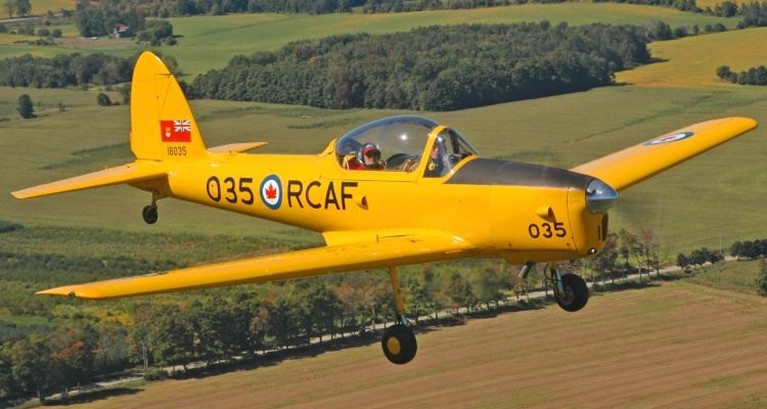
Royal Canadian Air Force Chipmunk with later bubble canopy 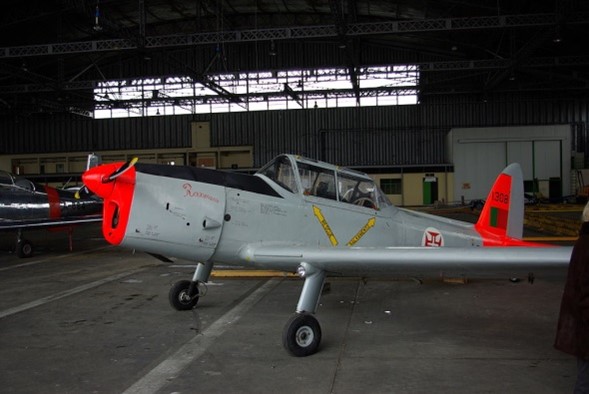
A Chipmunk in Portuguese Air Force markings
Both British-built and early Canadian-built Chipmunks are notably different from the later Canadian-built RCAF/Lebanese versions. Later Canadian-built aircraft were fitted with a one piece bubble canopy. On earlier canopies, the rearmost panels intentionally bulged in order to provide the instructor’s position with improved visibility. British-built Chipmunks also differed by a number of adjustments to suit the expressed preferences of the RAF. These included the repositioning of the landing gear, anti-spin strakes, landing lights, and an all-round stressed airframe.
The last 66 Chipmunks were licence-manufactured from 1955 to 1961 in Portugal for the Portuguese Air Force. The RAF withdrew the Chipmunk from service in 1996.
A total of 1284 aircraft were built.

Civilian Chipmunks
After retirement from the military, the Chipmunk became a very popular civilian aircraft as they were well built and robust.
Many Chipmunks were frequently modernised with newer engines and avionics, and used for various roles, such as pilot training, aerobatics and crop spraying.
Hundreds of Chipmunks are still flying around the world with a few here in South Africa.
Honourable mention – Art Scholl
The 1986 blockbuster film TOP GUN included one scene where the character Maverick, inadvertently entered an inverted flat spin in the F-14 Tomcat that killed his RIO “Goose”.
Art Scholl was an experienced and well-known air show performer, professor, and head of the Department of Aeronautics at San Bernardino Valley College. He lost his life while filming the movie.
He was also a flight instructor, and a film and production pilot who had worked on hundreds of hit TV shows and movies including Iron Eagle, The A-Team, and Indiana Jones, to name just a few.
Art had been approached to film some background shots on Top Gun – known as ‘plate shots’ – which are used as a backdrop behind the actors on a green screen during filming.
The requested footage was the inverted flat spin filmed from the pilot’s perspective.
On September 16th, 1985, Art headed out with an observer aircraft following to capture several sequences of flat spins. In the first sequence his camera caught the observer aircraft in the filming, so Art requested that they back off a couple of miles to avoid spoiling the shot.
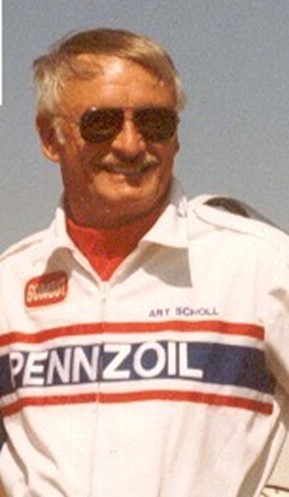
The observer aircraft obliged by backing off, and inadvertently lost sight of Art.
Moments later Art radioed that he was entering another inverted flat spin approximately five miles off the Californian coast – near Carlsbad.
‘Part way down he radioed again saying, “I have a problem” and then about three seconds later he said, ‘I have a real problem.’
By the time the observer aircraft closed its distance, he was gone.
After a while, the Coast Guard gave up the search citing the water was too deep to recover the aircraft.
Neither Art Scholl, nor or his Super Chipmunk was ever seen again…
The producers decided that the movie TOP GUN would be dedicated to Art’s memory.