Arc Aero Systems, formerly Samad Aerospace, has revealed a “cost-effective, low-carbon solution to intercity travel”, the hybrid Linx P9.
Images: Arc Aero Systems
Arc says their proposal will beat comparably sized helicopters from operating costs, speed and range.
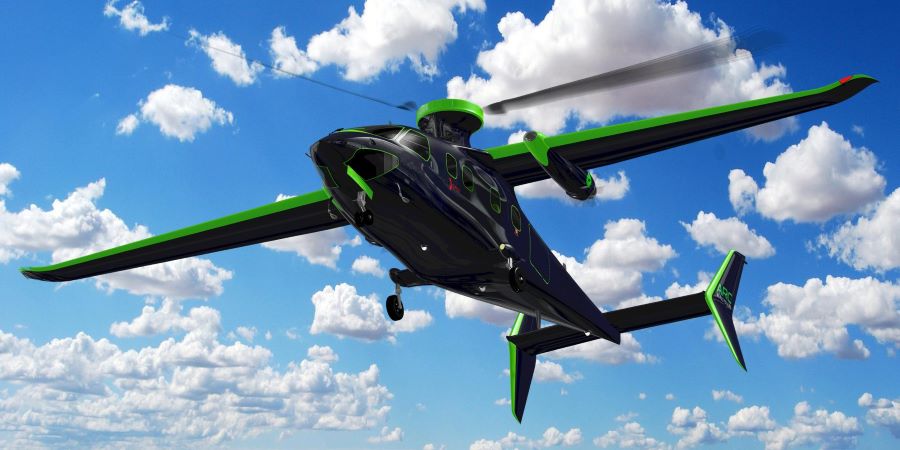
Looking like a cross between a traditional fixed wing aircraft and a helicopter, the fully composite fuselage seats nine people, excluding the two crew members. The high mounted main wing has a high aspect ratio and is rather slim looking very much like a high performance glider wing, measuring out at 12.6m.
Two pusher combustion turbo-engines are mounted on the wings and are rated at 370-kW (496-hp) driving a pair of 2m propellers. Arc says that the engines will use sustainable aviation fuel (SAF) to make the aircraft more eco and environmental friendly. Arc says that they are working on using hydrogen fuel cell power plants for later models.
The large 13m main rotor is pitch-controllable, but not from a collective control in the cockpit. Noticeably absent is the traditional tail rotor of a conventional helicopter. Instead, a large tail wing and double vertical fins help counter gyroscopic forces. An electric motor spins the main rotor for vertical takeoff and landing. Somewhat like a gyroplane, but not needing forward speed to build revolutions of the rotor.
The total weight of the aircraft is relatively light at just 1,930kg, just short of two tons.
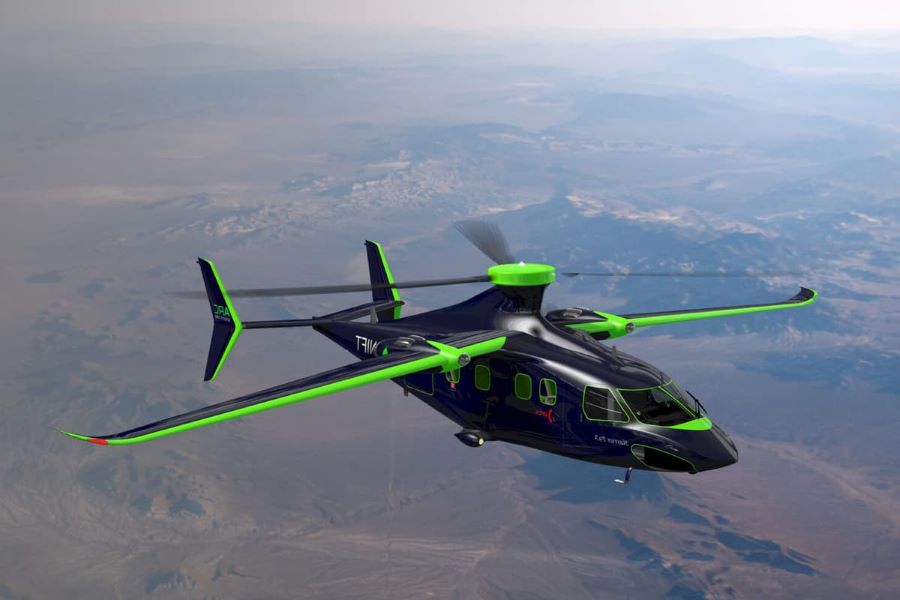
Once airborne, the main pusher props power up increasing the airspeed to the point where the wings take over 90% of the lift, and the top rotor is slowed down to reduce drag.
Asymmetrical lift on the retreating blade is also drastically reduced, allowing a maximum forward cruise speed of 230mph (370kph).
Arc says the pusher props will run on sustainable aviation fuel, or potentially be replaced by a hydrogen fuel cell powertrain at some point.
The Linx P9’s length and speed make this aircraft ideally suited for regional type routes as Arc says the aircraft is designed for a 590 NM (950 km) range in a standard configuration using some 1,320 lb (600 kg) of fuel, or an 808 NM (1,300 km) range with an extended-range tank fitted.
Compared to a traditional helicopter like the Sikorsky S-92 which cruises at 174 mph (280 kph) and gets a maximum 630 nm (1,014 km) range using 5,130 lb (2,333 kg) of fuel, these figures seem very ambitious. However one must remember that the Sikorsky weighs more than four times of the Linx P9, so in fact could be attainable.
Arc says you can operate this aircraft for around USD505 per flight hour, about a 40% reduction from the cost of comparable helicopters.
Arc’s design is similar to the 1998 CarterCopter concept, but somewhat larger. Unfortunately the CarterCopter crashed in June 2005, and now since inoperable.
According to Arc, the slowed-rotor concept offers better advantages over most eVTOL air taxi designs. Firstly, the huge top rotors can act like parachutes in the case of total power failure, allowing autorotation to a safe landing which eVTOLs cannot match.
Secondly, the Linx P9 design is certifiable under existing regulations. This is a huge advantage for manufacturers and relatively well-understood by aviation authorities.
This reduces investor risk, and establishes a known set of operating regulations.
ARC’s CEO, Seyed Mohseni, believes the Linx P9 could be the missing link in achieving advanced air mobility: “It’s a very exciting design concept that is the ultimate solution for the market, that is affordable, safe and practical, whilst providing the right answer to the current environmental concerns.”
However, because the design is not traditional, there could be patent challenges ahead for Arc, on top of the daunting task of developing, prototyping, certifying and producing the Linx P9.
Presently Arc is still looking for major investment as per most every other aerospace start-up company. However, Arc has set itself apart from many of its competitors, having successfully carried out test flights on their unmanned eVTOL cargo drones, the C-150 and C-600.