When you think of a warbird, large, ugly, monstrous, heavily armed, all come to mind with big strong names like Thunderbolt, Hurricane, Skyhawk, Flying Fortress.
So, when you mention Cessna Dragonfly, you probably would imagine a helicopter, because dragonflyies hover, why else?
But the A-37 Dragonfly is an attack aircraft, and it sits low to the ground, almost hugging it.
Developed from the T-37 Tweet basic trainer as a light attack aircraft, it earned the nickname of “Super Tweet”. The A-37 became one of the first counter-insurgency (COIN) jet aircraft, the role being previously undertaken by the propeller driven Douglas A-1 Skyraider. In the Vietnam conflict, the Skyraiders were taking a hammering with ever increasing losses. The Dragonfly was seen as a quick replacement using an existing airframe without the need for a completely new design.
In 1963, the US Air Force awarded a contract to Cessna for two prototype “YAT-37D” aircraft, with the first prototype flying in October 1964, followed a year later by the second prototype.

These prototypes had shorter wings, fixed tiptanks, three underwing pylons per wing, a minigun and a more robust landing gear. Despite good results, interest faded, and the program was stopped.
However, in early 1967, the Air Force contracted Cessna for 39 AT-37Ds, with a few minor changes relative to the prototypes, to be rebuilt from existing T-37Bs. These aircraft were later re-designated as A-37As. The A-37s were to be used as COIN aircraft and were sent to Vietnam in August 1967 as part of the Combat Dragon evaluation program, flying close air support, forward air controller (FAC), night missions and helicopter escort support.
“No other aircraft had ever gone into combat that hadn’t been tested previously. Other fighters were proven here in the States. That’s not the case with the A-37. This aircraft went over to prove itself in combat,” said USAF fighter pilot Lon Lotz. By December 1967, the A-37A had flown 3,000 missions and without any losses to enemy fire. However, two aircraft were lost due to landing accidents.
The A-37A was formally named the “Dragonfly”, but most pilots called it the “Super Tweet”.
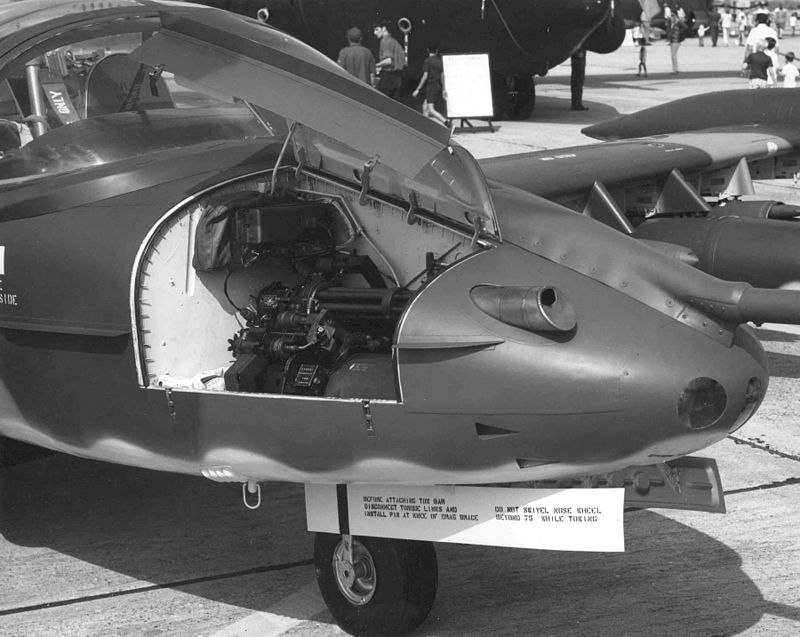
The A-37 carried an impressive amount of armament for such a small aircraft. In the aircraft’s nose was a single 7.62 mm General Electric GAU-2B/A minigun. With eight pylons, three under each wing and two beneath the fuselage, the A-37 could carry 3,000 pounds of bombs, rockets and missiles.
The aircraft was powered by two General Electric J85-GE-17A turbojets, each producing 2,400 pounds of thrust. Top speed was between 485-507 MPH.
Some issues were realised with the “A” model, like the lack of range and endurance. This lead Cessna to develop the A-37B, a purpose built variant, featuring larger fuel tanks, a re-fuelling probe, a heavier fuselage and a bigger engine. The initial order was for 57 aircraft, but was quickly increased to 127 aircraft.
In combat, the A-37 Dragonfly enjoyed pinpoint accuracy within a 45 foot radius because it could fly slower than other sweptwing jet aircraft, with speeds as low as 100mph.
A-37s were used by the Republic of Vietnam Air Force, as well as the US Air Force. In total, the A-37 flew 68,471 missions between 1967-74. Some sources quote more than 160,000 combat sorties. Despite so many missions, the A-37 has been largely overlooked in favour of Vietnam’s “Heavy Metal,” the F-4 Phantom, the F-100 Super Sabre and the F-105 Thunderchief.
Interestingly, the A-37 continued to serve with the Air National Guard and Air Force Reserve after Vietnam, eventually being replaced by the Fairchild Republic A-10 Thunderbolt.
The A-37 is currently flown by six different air forces in Central and South America, fitting perfectly within the needs of Latin American air forces, mainly for counter insurgency and counter-narcotics operations. The A-37 was used extensively during the Salvadoran Civil War.
A total of 577 A-37 combat aircraft were built, excluding the original trainer version.