“The De Havilland Tiger Moth vs Boeing Stearman”
(PART ONE) Elton Bondi – The first article in this series about historically significant and unusual airplanes, described the vintage De Havilland Tiger Moth, brainchild of the famous British aircraft designer Geoffrey De Havilland.
By modern standards, the Tiger is a somewhat quirky airplane which, whilst easy enough to fly, is relatively difficult to fly precisely, and why it was such a great trainer.
The Tiger has awful ailerons, poor control harmony (by modern standards) can be cantankerous to maintain; but is none-the-less coveted by enthusiasts around the world for its charisma and nostalgia as well as for the important role it played in training thousands of World War Two allied pilots. There can be no doubt nothing symbolises early British aeronautics quite like the Tiger Moth, an aircraft that will always enjoy a well-earned place in pre- and post- war English aviation history.
On the other side of the Atlantic around the same time that the Tiger was first flown, another Biplane was being designed: the famous Boeing Stearman – an icon of aviation art deco ‘Americana’ if ever there was one.
Much like the Tiger Moth, the Stearman emanated from the pen of a celebrated designer Mr Lloyd Stearman, who like Geoffrey De Havilland was well known for his successful line of Pre-war civilian biplanes that were used to ferry mail across continental USA in the 1920s.
By 1934, Stearman Aircraft became a subsidiary of the fast-growing Boeing Corporation.
Like the Tiger Moth, the Stearman model 75 Kaydet or PT-13 (primary trainer number 13) was based on a successful earlier civilian design, which like the Tiger, was also modified to become a military trainer. But other than it being a biplane with civilian origins that was adapted to military specifications, the Stearman is vastly different to the Tiger.
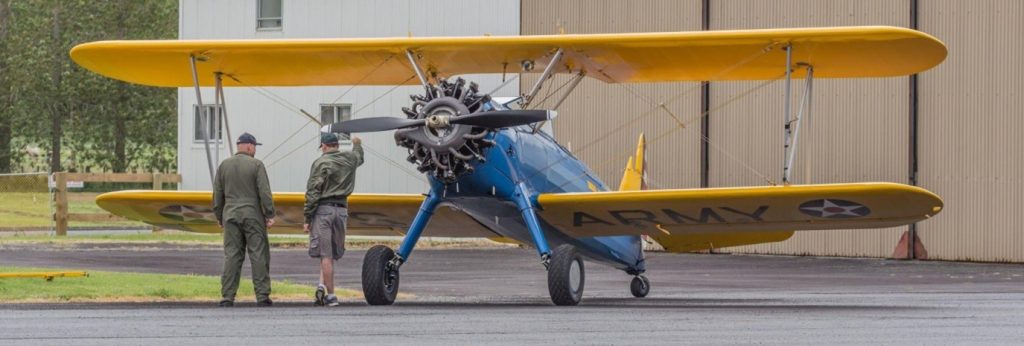
Firstly, for a light aircraft the Stearman is huge, intimidatingly so, at least for me. This machine was clearly designed in a land with big skies, wide-open spaces and large Texan cowboys. There is nothing cute or quaint about it. The cockpit is cavernous and even sitting on a pile of cushions you battle to see around the bulbous engine.
The big radial motor is an aficionado’s delight, its oil splattering smoky start-up followed by its throbbing idle adds to the intimation factor. This is no super-efficient, eco-friendly, computer governed, electronically controlled, simple to operate, modern light-sport powerplant. Rather this is a big, heavy, crude, oily, smoky round aeroplane engine that screams “for leather helmet and goggles clad aviators only”.
The original PT-13 Stearman came out with a 220hp Lycoming radial engine. This seems too little power for such a large aircraft. However, it has a lot of wing area and so doesn’t need that much speed to fly. I have never flown a 220hp Stearman; those who have, tell me that they fly beautifully with no deficit in either take-off or climb performance, even up here on the high density altitude Highveld.
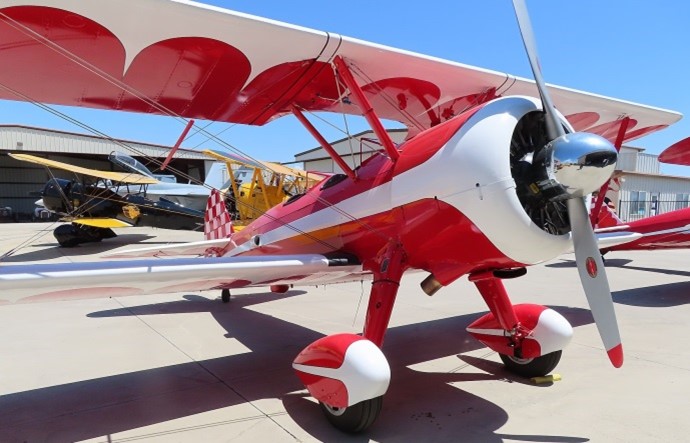
The 450hp P&W powered Stearman. 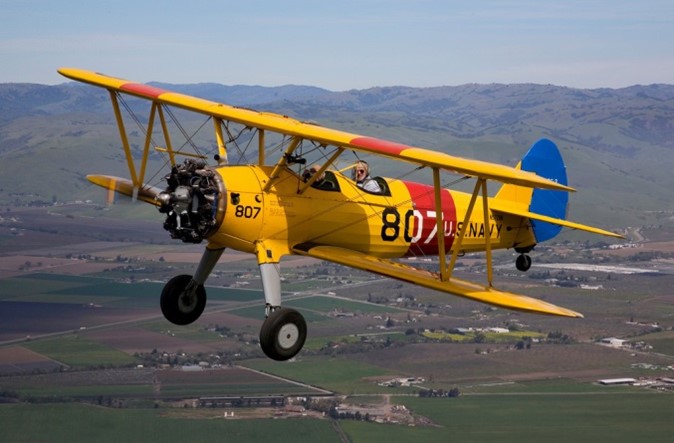
The 220hp Lycoming powered Stearman.
After the war, many crop sprayers and airshow performers bolted 450hp radial engines on their Stearman’s. It does not surprise me that although doubling the power provided better take-off, climb and load carrying capability, the earlier lower powered variants were nicer to fly because they were lighter and better balanced. This is true for many aircraft that were later modified with more power. For example – the lighter Pitts S2A is more pleasant to fly than that heavier more powerful S2B, and the Cessna 180 is sweeter than the Cessna 185. I am told the same holds true for beefed-up airliners.
I have only flown the 450hp Stearman; hence my impressions of the airplane are based on that variant only. Despite its intimating size, and challenging cockpit visibility, the Boeing Stearman is a truly magnificent airplane to fly.
It is easy enough to keep straight on the take-off roll, just remember to open the power slowly. It gets airborne effortlessly and climbs out with vigour, and it rides along in the air as if on rails – very solid and stable.
Controls are understandably a little heavier than say a Piper Cherokee, but they are surprisingly light for a large aircraft with excellent and well balanced control response.
Unlike contemporary aircraft, significant rudder work is required to keep the airplane balanced in turns; another reason why it is such a great trainer.
All in all, a Stearman is nothing less than a sheer delight in the air. I say this in a whisper, and with some trepidation given the close relationship South Africa has with British aviation – but the Stearman has a far nicer feel in the air than a Tiger Moth.
(Continued in PART TWO.)