
By Michael Thompson
Cape Town International Airport (ICAO code FACT, IATA code CPT) is located about 20km from the city’s CBD and is South Africa’s second busiest airport, and Africa’s third busiest, handling more than 10 million passengers annually. It serves as a vital transportation hub for the Western Cape province, linking the residents of the province to a network of domestic, regional and long-haul destinations.
The airport handles an interesting mix of business, leisure and private traffic as well as freight and ad-hoc flights. In this article we look at Cape Town airport past, present and future and we examine what it is like to operate into this beautiful destination from a pilot’s perspective.
History
Opened in 1954, the airport was originally named Bellville Airport after the suburb closest to it; however, it was soon renamed DF Malan Airport, after the then South African Prime Minister.
It was built to replace the old Wingfield Aerodrome, which had served as Cape Town’s main airfield before and during World War II and which saw both civilian and military traffic, including air force training. In its early years, the airport primarily handled domestic traffic, with a few international flights, most notably to the UK.
The original terminal was small, with limited capacity, reflecting Cape Town’s relatively modest air traffic at the time.
By the 1970s, Cape Town was becoming a popular tourist destination and an important economic hub requiring larger facilities, and so a new international terminal was constructed in 1977. At the time, despite apartheid era sanctions, international flights linking the city with Europe in particular were increasing in frequency.
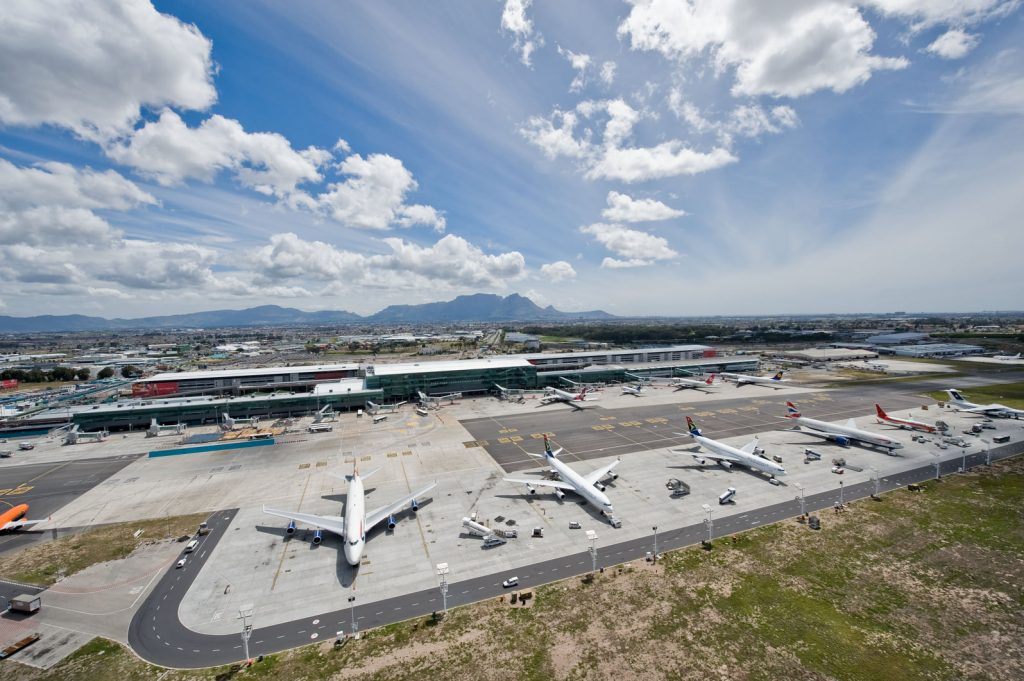
With South Africa’s democratic transition in the early 1990s, international travel to and from Cape Town surged. In 1995, the airport was renamed Cape Town International Airport to reflect the new era and growing global connectivity and in an attempt to throw off its apartheid era associations. New routes to Europe, the Middle East, the Far East and South America and other parts of Africa were added as South Africa rejoined the international community.
The airport underwent major expansion projects in the 2000s, driven largely by the need to modernise ahead of the 2010 Soccer World Cup, for which Cape Town was a major host city.
Improvements included a new central terminal building, completed in 2009, which linked the domestic and international terminals under one roof, upgraded runways, taxiways and apron facilities and a new cargo facility as well as expanded retail, dining and passenger services.
Cape Town airport today
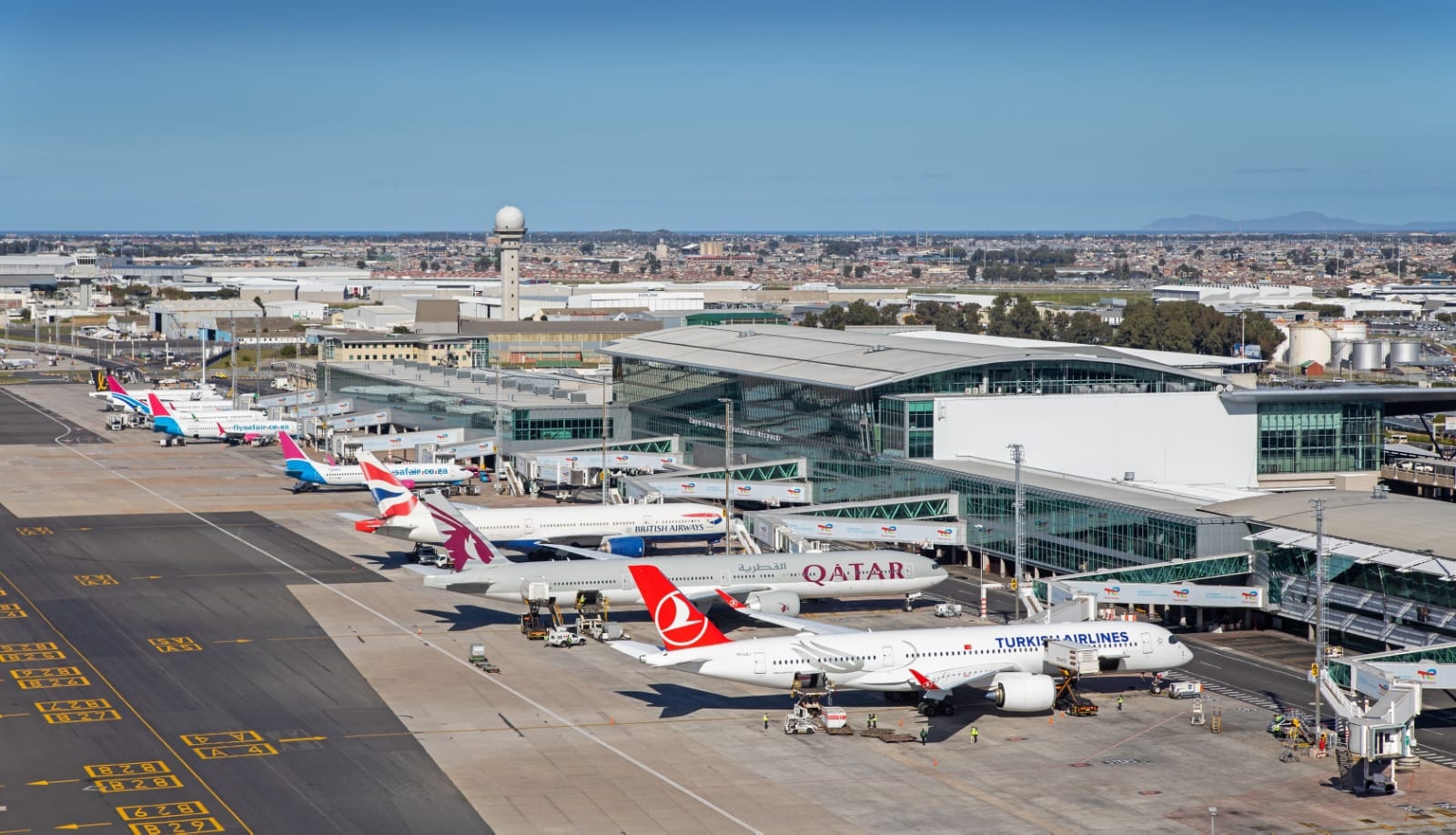
Today Cape Town International is an exemplary hub, winning several awards including the coveted Skytrax Best Airport in Africa 2025 award and World’s #1 Airport 2025 in the AirHelp awards. Passenger numbers continue to grow steadily, with strong demand from Europe and Asia (especially the UK, Germany, the Netherlands and Singapore), as well as newer routes to the Middle East (Qatar, UAE, Turkey) and North America.
It provides vital links to the rest of South Africa too, with domestic carriers FlySafair, Airlink, CemAir and South African Airways flying from Cape Town to all the country’s major centres.
General aviation is represented in the form of two fixed-base operators (FBOs) – Signature Aviation and Execujet – which handle a large number of private and VIP flights including some interesting seasonal charter flights to Antarctica.
Operating into Cape Town International – A pilot’s perspective
Cape Town International is a joy to operate in and out of. Not only is it located in one of the world’s most scenic settings, but it has outstanding facilities and exemplary air traffic control.
The airport has two runways: 01/19 and 16/34. The 3,201m long runway 01/19 is the predominantly used runway and it aligns largely with the airport’s prevailing north-east/south-west wind directions meaning that headwinds rather than crosswinds are more often encountered. Having said that, Cape Town is absolutely notorious for its wind and wind speeds in excess of 20kts are common. Runway 16/34 is used occasionally and, at a length of 1,701m, it is sufficient for most light jets. 01-19 is equipped with outstanding High Intensity Runway Lights and Touchdown Zone Lighting as well as Precision Approach Path Indicator (PAPIs) and full approach lighting as well as Runway Visual Range transmissometers, while 16/34 is more basically equipped with just High Intensity Runway Lights and PAPIs.

Cape Town Airport is served by a VOR beacon as well as Instrument Landing Systems on both runway 01 and 19, both down to CAT II minimums with 01 having CAT IIIB capability. RNAV (GNSS) approaches are available to 01, 19 and runway 34.
Full air traffic control services are available 24 hours a day, as is customs and immigration, rescue and firefighting and fuel, including JET A1 and Avgas.
Cape Town International serves a mixture of types of traffic and, while it is predominantly airline traffic you’ll encounter, there are a number of foreign private jets, the occasional visiting military aircraft, turboprop charter aircraft as well as small light piston training aircraft in the airspace.
Terrain is a factor when operating into and out of Cape Town. The iconic Table Mountain lies 8NM west of the airfield and towers to a height of around 3,500ft AMSL while the mountains of Paarl and Stellenbosch rise up to the east, necessitating a minimum sector altitude of 9,000ft in that direction. Good situational awareness is vital, although ATC are fastidious about only descending traffic once clear of the high ground in their sector.
Weather is probably the single biggest challenge when operating into Cape Town. The city is not only known for its strong winds but also for how changeable its weather can be. It is often said that Cape Town can experience all four seasons in a single day and this is true!
In a few hours, the airport can experience sunny skies, heavy rain and then thick fog. In fact, fog and mist are one of Cape Town’s hallmark weather phenomena, making the occasional need for a CAT II approach a real possibility. For VFR pilots, this means that extra careful checking of the Terminal Aerodrome Forecast (TAF) is a necessity that is not just good airmanship but may just save your life.
When departing or arriving IFR, most routings will turn inland; however, “scenic” arrivals or departures may be requested and will likely be accommodated by ATC depending on how busy the airspace is. These provide absolutely breathtaking views of the city, Table Mountain, Camps Bay and False Bay.
Final thoughts
Cape Town Airport is an absolute joy to operate from. From its stunning scenery to its sometimes challenging weather, it is one of the best places a pilot could possibly fly.